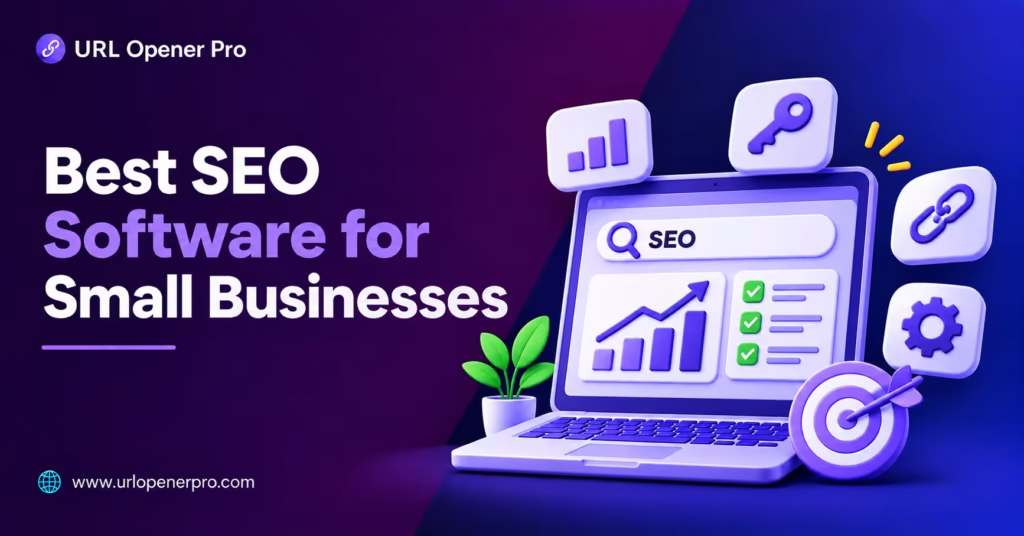
The best SEO software for small businesses starts with three free tools, Google Search Console, Ahrefs Webmaster Tools, and the Screaming Frog SEO Spider, then adds one paid platform such as Semrush, Ahrefs, SE Ranking, Moz Pro, Mangools, or Ubersuggest. This list ranks 13 tools by who they fit, with pricing checked in November 2026 and the limit that matters for each.
A five-page local site does not need a $249 per month platform. The best SEO software for small businesses answers three questions at the lowest cost: which searches bring visitors, what is broken on the site, and which competitors rank for the terms you want. Each tool below is tagged with the job it does best, what it costs, and where it runs out of room, so you can build a stack instead of buying the biggest suite first.
What are the best SEO software tools for small businesses at a glance?
The 13 best SEO software tools for small businesses are Google Search Console, Ahrefs Webmaster Tools, Screaming Frog, Semrush, Ahrefs, SE Ranking, Moz Pro, Mangools, Ubersuggest, Rank Math, Yoast SEO, Sitebulb, and URL Opener Pro. Three are free, two are WordPress plugins, and the rest are paid platforms or auditors.
Prices are in USD unless noted, were checked in November 2026, and change often, so confirm each figure on the vendor’s pricing page before buying.
| # | Tool | Best for | Starting cost |
|---|---|---|---|
| 1 | Google Search Console | Your own clicks and indexing problems | Free |
| 2 | Ahrefs Webmaster Tools | Free audit and backlinks for your own site | Free |
| 3 | Screaming Frog SEO Spider | Broken links and redirects | Free up to 500 URLs, or €245 per year |
| 4 | Semrush | All-in-one research, audits, and tracking | $139.95 per month (Pro) |
| 5 | Ahrefs | Backlink and competitor research | $129 per month (Lite) |
| 6 | SE Ranking | Rank tracking with audits for small teams | Paid only, confirm current price |
| 7 | Moz Pro | Beginners who want guided metrics | Under $50 per month |
| 8 | Mangools | Simple keyword research for solo owners | $61 per month, or $37.70 billed annually |
| 9 | Ubersuggest | Low-cost keyword ideas and a basic audit | Free tier, then $29 per month or $290 lifetime |
| 10 | Rank Math | On-page SEO inside WordPress | Free, Pro $59 per year |
| 11 | Yoast SEO | Beginner-friendly WordPress SEO | Free, Premium $118.80 per year per site |
| 12 | Sitebulb | Visual technical audits | Paid, 14-day free trial |
| 13 | URL Opener Pro | Opening exported URL lists in one click | Free up to 10 URLs |
The selection rule is short. If the site has fewer than 100 pages and you track fewer than 100 keywords, the free tools plus one entry-level paid plan cover the work. Pick from the table below by situation.
| Situation | Best pick | Benefit |
|---|---|---|
| Zero budget | Google Search Console plus Ahrefs Webmaster Tools | Search data and a site audit at no cost |
| Solo owner needing keyword ideas | Mangools or Ubersuggest | Low learning curve and a small monthly bill |
| One dashboard for everything | Semrush or SE Ranking | Research, audits, and tracking in one login |
| Backlinks drive your strategy | Ahrefs | Deep link data on competitors |
| WordPress site | Rank Math or Yoast SEO | Titles, schema, and sitemaps handled in the editor |
The mistake most owners make is buying a large suite for a small site. A bakery that wants to rank for 40 local terms never needs 5,000 tracked keywords.
Which free SEO tools are best for small businesses?
The best free SEO tools for small businesses are Google Search Console, Ahrefs Webmaster Tools, and the Screaming Frog SEO Spider. Together they cover search performance, site health, and broken-link detection at no cost.
1. Google Search Console
Google Search Console is Google’s free tool for seeing how your own site performs in search. The Performance report shows queries, pages, clicks, impressions, click-through rate, and average position, and keeps 16 months of data.
- Best for: every small business, as the first tool to set up
- Pricing: free
- Standout features: Performance report, Page indexing report, URL Inspection tool, sitemap submission, Core Web Vitals report
- Limitation: Google Search Console shows only searches you already appear for, and offers no competitor data
Sort queries by impressions and look for terms where average position sits between 8 and 20. Those pages already earn visibility and often need only a stronger title or a longer answer to reach page one.
2. Ahrefs Webmaster Tools
Ahrefs Webmaster Tools gives site owners Ahrefs data on their own verified site, including a site audit and backlink information. The free tier excludes keyword research, backlink analysis of other sites, rank tracking, and competitor analysis.
- Best for: owners who want a free technical audit and a view of who links to their site
- Pricing: free, limited to your own verified sites
- Standout features: site audit, backlink data for your own domain
- Limitation: Ahrefs Webmaster Tools cannot research competitors or keywords
Fix issues marked as errors before warnings. The common mistake is treating every warning as urgent, which sends a small team chasing cosmetic issues while real errors stay open.
3. Screaming Frog SEO Spider
The Screaming Frog SEO Spider is a desktop crawler that scans a website the way a search engine does and lists broken links, redirects, and missing page titles. The free version crawls up to 500 URLs, which covers most small business sites, and the paid licence costs €245 per year.
- Best for: finding broken links, redirect chains, and missing titles
- Pricing: free up to 500 URLs, €245 per year for unlimited crawling
- Standout features: Response Codes tab, redirect reports, bulk CSV export
- Limitation: Screaming Frog has no keyword data or rank tracking
To find broken pages:
- Open the SEO Spider, enter your homepage URL, and click Start.
- Wait until the crawl reaches 100%.
- Open the Response Codes tab and set the filter to Client Error (4xx).
- Select a broken URL and open the Inlinks tab to see which pages link to it.
- Click Export to save the list as a CSV file.
Step 4 matters most. The broken URL is a symptom, and the pages linking to it are the fix: update the link, or add a redirect to the closest live page.
Which paid SEO platforms are best for small businesses?
The best paid SEO platforms for small businesses are Semrush, Ahrefs, SE Ranking, Moz Pro, Mangools, and Ubersuggest. All six cover keyword research, and they differ mainly in price, tracking limits, and how much data they give on competitors.
4. Semrush
Semrush is an all-in-one SEO platform that combines keyword research, site audits, and rank tracking in one dashboard. The Pro plan costs $139.95 per month ($117.33 per month billed annually), covers 5 projects, tracks 500 keywords, and crawls 100,000 pages per month.
- Best for: owners who want one subscription for research, audits, and tracking
- Pricing: $139.95 per month for Pro
- Standout features: Keyword Magic Tool, Site Audit, Position Tracking
- Limitation: Pro costs more than twice the Mangools Basic monthly rate, so a single-site owner tracking 50 keywords pays for unused capacity
5. Ahrefs
Ahrefs is a backlink and competitor research platform built around Site Explorer, Keywords Explorer, Site Audit, and Rank Tracker. The Lite plan costs $129 per month and the Standard plan costs $249 per month.
- Best for: strategies that depend on links and competitor analysis
- Pricing: $129 per month (Lite), $249 per month (Standard)
- Standout features: Site Explorer backlink index, Keywords Explorer, Rank Tracker
- Limitation: costs climb fast as you add projects, and the free Ahrefs Webmaster Tools tier already covers basic audits for your own site
Upgrade to Lite when you need to study which sites link to your competitors and replicate the best of those links.
6. SE Ranking
SE Ranking is an SEO platform that bundles rank tracking, keyword research, site audits, and backlink checking for small teams. SE Ranking sells paid plans tiered by projects and tracked keywords, and one 2026 pricing listing puts the entry plan between roughly $103 and $129 per month.
- Best for: small teams that want rank tracking and audits in one login
- Pricing: paid only, and pricing listings conflict on plan names, so check the vendor page
- Standout features: rank tracking, site audit, keyword research
- Limitation: reviewers report add-on charges and non-refundable subscriptions, so read the cancellation terms before paying annually
7. Moz Pro
Moz Pro is an SEO platform that pairs keyword research and site crawling with Domain Authority, Moz’s own 1 to 100 score that predicts how well a site may rank. Entry plans start under $50 per month.
- Best for: beginners who want guided metrics and plain-language reports
- Pricing: under $50 per month at entry level
- Standout features: Domain Authority, Keyword Explorer, Site Crawl
- Limitation: entry tiers cap tracked keywords and crawled pages, and Domain Authority is a comparison score, not a Google ranking factor
Use Domain Authority to compare your site against competitors. A rise of two points does not prove rankings improved.
8. Mangools
Mangools is a set of five SEO tools, KWFinder, SERPChecker, SERPWatcher, LinkMiner, and SiteProfiler, aimed at solo owners and freelancers. The Basic plan costs $61 per month, or $37.70 per month on annual billing.
- Best for: solo owners who want keyword research without a steep learning curve
- Pricing: $61 per month (Basic), higher tiers add seats and limits
- Standout features: KWFinder keyword research, SERPWatcher rank tracking
- Limitation: Basic allows 100 keyword lookups per 24 hours, up to 200 tracked keywords, and 1 seat
A team of three needs the Premium tier, which allows 500 lookups per 24 hours and 700 tracked keywords.
9. Ubersuggest
Ubersuggest is Neil Patel’s SEO tool for keyword ideas, a basic site audit, and limited competitor analysis. The free tier allows a small number of daily searches, the Individual plan costs $29 per month, and a $290 lifetime option exists.
- Best for: owners on the tightest budget who still want keyword ideas
- Pricing: free tier, $29 per month (Individual), $290 one-time (Individual lifetime)
- Standout features: keyword ideas, basic site audit, Chrome extension
- Limitation: one 2026 pricing review notes that lifetime plans carry smaller AI allowances, so confirm in writing which features the lifetime plan guarantees
Which WordPress plugins and audit tools help small business SEO?
The best WordPress SEO plugins for small businesses are Rank Math and Yoast SEO, and the best dedicated audit tool beyond Screaming Frog is Sitebulb. The plugins fix on-page SEO inside the editor, while Sitebulb explains technical problems visually.
| Factor | Rank Math | Yoast SEO |
|---|---|---|
| Free version | Unlimited sites, core features | Basic features |
| Focus keywords per post (free) | 5 | 1 |
| Redirect manager | Included free | Paid |
| Paid entry price | $59 per year | $118.80 per year per site |
The table reflects one February 2026 comparison, so confirm current prices before upgrading.
10. Rank Math
Rank Math is a WordPress SEO plugin that handles titles, meta descriptions, schema markup, and XML sitemaps inside the post editor. The free version allows five focus keywords per post and includes a redirect manager, and Rank Math Pro costs $59 per year.
- Best for: WordPress owners who want many features without a paid plugin
- Pricing: free, Pro from $59 per year
- Standout features: schema types, redirect manager, WooCommerce support
- Limitation: Rank Math only works on WordPress, and its large feature set takes longer to configure
11. Yoast SEO
Yoast SEO is a WordPress SEO plugin known for a simple setup and a readability checker that scores sentence length, paragraph structure, and transition words. The free version allows one focus keyword per post, and Yoast SEO Premium costs $118.80 per year per site.
- Best for: beginners who want clear on-screen guidance while writing
- Pricing: free, Premium $118.80 per year per site
- Standout features: readability checker, snippet preview, sitemap generation
- Limitation: Yoast SEO charges for features that Rank Math includes free, such as the redirect manager
Pick one plugin, not both. Running two SEO plugins on one site creates duplicate meta tags and conflicting sitemaps.
12. Sitebulb
Sitebulb is a paid website auditor that crawls a site and turns findings into prioritized Hints with visual crawl maps. Sitebulb offers a 14-day free trial but no free plan, and prices differ across listings, so check Sitebulb’s own pricing page.
- Best for: owners or freelancers who want audit findings explained, not just listed
- Pricing: paid, with a 14-day free trial
- Standout features: prioritized Hints, crawl visualizations
- Limitation: Sitebulb costs money while Screaming Frog’s free tier already crawls 500 URLs, so a small site rarely needs both
Which tool helps review the URLs that SEO software exports?
URL Opener Pro is a free web tool and Chrome extension that opens a pasted list of URLs as separate tabs in one click. Every tool above ends in an exported URL list, and a bulk URL opener turns the manual review of that list into a single action.
13. URL Opener Pro
Consider an illustrative scenario: a 60-page site shows 25 “Not found (404)” URLs in the Google Search Console Page indexing report. The owner exports the list, pastes it into URL Opener Pro, and opens every page at once to decide which should redirect and which should return a 404 on purpose.
| Factor | Detail | Benefit |
|---|---|---|
| Free plan | Opens up to 10 URLs, ad-supported | Handles a short audit list at no cost |
| Pro plan | 500+ URLs, CSV upload, saved URL groups, no ads | Handles a full audit export |
| Lifetime plan | $99 one-time, up to 5 users | Covers a small team with one payment |
| Privacy | Client-side, no login, no stored data | Keeps client URL lists in your own browser |
| Browser support | Chrome, Firefox, Edge, Brave | Works with whichever browser the team uses |
- Best for: reviewing exported lists from Google Search Console, Screaming Frog, Semrush, or Ahrefs
- Limitation: URL Opener Pro opens pages only, with no crawling, scoring, or rank data, so it complements the tools above and does not replace them
Opening hundreds of tabs uses browser memory, so open large lists in batches and allow pop-ups for the site if the browser blocks the tabs.
Conclusion
The best SEO software for small businesses is the setup you open every week, and for most owners that means free tools first. Connect Google Search Console and Ahrefs Webmaster Tools today, crawl the site with the Screaming Frog SEO Spider, and fix every 4xx error before paying for anything.
Add one paid platform only after the free data stops answering your questions: Mangools or Ubersuggest for light research, Semrush or SE Ranking for an all-in-one dashboard, Ahrefs for backlinks. Then export the URL lists and review them in one pass with URL Opener Pro.
Frequently Asked Questions
What is the best SEO software for a small business with no budget?
Google Search Console, Ahrefs Webmaster Tools, and the free Screaming Frog SEO Spider form the best zero-cost stack. Google Search Console reports your clicks and indexing problems, Ahrefs Webmaster Tools runs a site audit and shows backlinks, and Screaming Frog crawls up to 500 URLs for free.
Is Google Search Console enough for small business SEO?
Google Search Console is enough for monitoring a small site but not for planning content. Google Search Console shows queries you already appear for, with 16 months of data, and offers no competitor rankings or missing keywords. Add a keyword tool such as Mangools or Ubersuggest when you need new topic ideas.
How much does SEO software cost for a small business?
Entry-level paid SEO software costs roughly $30 to $140 per month. Ubersuggest Individual costs $29 per month, Moz Pro starts under $50, Mangools Basic costs $61 ($37.70 billed annually), Ahrefs Lite costs $129, and Semrush Pro costs $139.95. Vendors change plans often, so check the current price before buying.
Should a small business choose Semrush or Ahrefs?
Choose Semrush if you want keyword research, audits, and rank tracking in one dashboard, and choose Ahrefs if backlink and competitor research matter most. Semrush Pro costs $139.95 per month and Ahrefs Lite costs $129 per month. Both exceed what a single-site owner needs if the free tools already answer the questions.
Is Moz Pro good for beginners?
Moz Pro suits beginners because Moz Pro explains its metrics and gives one Domain Authority score on a 1 to 100 scale. Entry plans start under $50 per month. The limit is capacity: entry tiers cap the keywords tracked and pages crawled.
What is the best free SEO crawler?
The Screaming Frog SEO Spider is the best-known free SEO crawler. The free version crawls up to 500 URLs, which covers most small business websites, and the licence costs €245 per year when you need unlimited crawling. Run it monthly and export the Client Error (4xx) list from the Response Codes tab.
Is Rank Math or Yoast SEO better for a small business WordPress site?
Rank Math includes more features free, while Yoast SEO offers a simpler setup and a readability checker. Rank Math’s free version allows five focus keywords per post and a redirect manager, and Yoast’s free version allows one focus keyword. Install only one of them, because two SEO plugins create duplicate meta tags.
Is Ubersuggest worth it for a small business?
Ubersuggest is worth trying when budget is the main constraint. The Individual plan costs $29 per month or $290 one-time, and the free tier allows a small number of daily searches. Confirm what the lifetime plan includes, because one 2026 review notes smaller AI allowances on lifetime plans.
Does a small business need rank tracking?
A small business needs rank tracking only when it can act on the data. A local business with 20 to 100 target keywords benefits from weekly tracking, but a site with no content plan gains little. Google Search Console already reports average position for free, so start there before paying for a tracker.
Is Google Business Profile SEO software?
Google Business Profile is a free listing manager, not an SEO suite. Google Business Profile controls how a local business appears in Maps and local search results, and it does not audit your website or track keywords. Use it for local visibility and a separate tool for website SEO.
How often should a small business run a site audit?
A small site should run a site audit once a month and after every major change, such as a redesign or a URL restructure. Monthly audits catch new broken links early. Screaming Frog, Ahrefs Webmaster Tools, Semrush Site Audit, and Moz Pro all run these checks.
How do I check many URLs from an SEO audit quickly?
Export the list to a CSV file, then paste it into a bulk URL opener such as URL Opener Pro, which opens every address as a separate tab in one click. The free plan opens up to 10 URLs, and the Pro plan opens 500+ URLs with CSV upload. Review the tabs, note which pages need a redirect or a fix, and close the rest.