For the customer, KYC verification takes about two minutes. Take a photo of your ID, take a selfie, wait for a green tick. For the company on the other side, those two minutes trigger a chain of checks, each one a place where fraud can slip through or a good customer can be wrongly turned away.
This guide follows a single verification from start to finish, then looks at what a KYC verification system needs to do that job well, where attackers push hardest, and what to ask before you build or buy one.
KYC stands for Know Your Customer. Banks, fintechs, crypto exchanges, payment companies and other regulated businesses use it to confirm who a customer is and whether they carry risks such as sanctions exposure. Requirements vary by country, so treat this as a general guide and confirm local rules with a compliance professional.
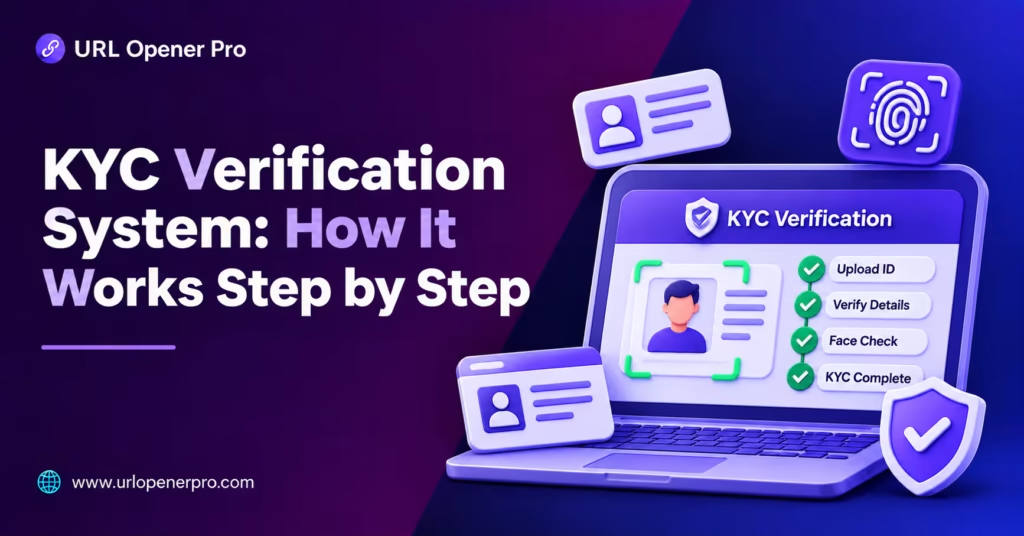
Follow One Customer Through the Check
Imagine someone opening an account on a payments app. Here is what happens, step by step, with the customer’s view and the system’s view side by side.
- The customer enters basic details. Name, date of birth, address, phone number. Behind the scenes, the system already starts scoring risk: is the email new, is the device known, does the phone number belong to a virtual provider, does the IP address match the stated country?
- The customer photographs an ID. The system checks whether the document is a real type for that country, reads the text and the machine-readable zone, compares fields against each other, and looks for signs of tampering, screen capture or a photocopy. Some systems also read chips in passports using NFC, which is much harder to fake than a printed page.
- The customer takes a selfie. The system compares the face to the ID photo and runs a liveness check to decide whether a real person is in front of the camera. Passive liveness analyzes a single capture or short video. Active liveness asks for a movement such as turning the head.
- Data checks run in the background. The details are matched against reliable sources where available: credit bureaus, government or telecom databases, and address records. In the United States, a bank’s customer identification program has to collect at least a name, date of birth, address and identification number, and verify them using risk-based procedures.
- Screening. The system checks names against sanctions lists, politically exposed person (PEP) lists and adverse media. Matches on common names produce many false alerts, so the quality of matching logic matters a great deal here.
- Risk scoring and a decision. Signals from steps 1 to 5 combine into a risk level. Clean cases pass automatically. Borderline ones go to a human reviewer. Clear failures are declined.
- Record keeping. The decision, the evidence and the reason are stored in an audit trail that a regulator can inspect later.
Everything from step 2 onward can fail in two directions: letting a fraudster in (false accept) or blocking a legitimate customer (false reject). A good system manages both.
What a KYC Verification System Is Made Of
You can think of a KYC verification system as six layers working together.
Document verification: reads and authenticates IDs, passports and licenses across many countries and templates
Biometrics and liveness: face matching plus checks that detect presentation attacks, such as photos or masks, and digital injection
Data and database checks: confirmation of identity attributes against trusted sources
Screening: sanctions, PEP and adverse media checks, with ongoing monitoring
Risk engine and rules: configurable logic that decides when to approve, review or decline based on customer type, country and product
Case management and audit: tools for reviewers, evidence storage, reporting and retention controls
For businesses, there is a seventh item that gets overlooked: business verification (KYB). If you onboard companies, you need to identify the entity and, in many jurisdictions, its beneficial owners. In the US, the FinCEN Customer Due Diligence rule requires covered financial institutions to identify and verify individuals who own 25% or more of a legal entity customer, plus one person with control.
Where Attackers Push Hardest
Fraud against remote identity checks is changing quickly, and vendors that process large volumes publish useful data. These are vendor reports, so read them as indicators, not final measurements.
- Entrust’s 2026 Identity Fraud Report, built from more than a billion verifications, says deepfakes now sit behind roughly one in five biometric fraud attempts. Deepfake selfies rose 58% in 2025 and injection attacks rose 40% year over year. Digital forgeries made up 35% of document fraud, up from a 29% average across 2022 to 2024
- iProov’s 2026 threat report, quoted in industry summaries, recorded a 741% annual increase in biometric injection attacks
- Sumsub’s 2025-2026 report found synthetic identities behind 21% of first-party fraud in 2025, the single largest category in its data
The key idea is injection. In a presentation attack, a fraudster holds a photo or screen up to the camera. In an injection attack, they skip the camera entirely and feed a prepared video into the software, using virtual cameras or emulators. A system built only to detect photos on screens can miss it.
There is another uncomfortable finding. Entrust reported that 82% of payment fraud attempts now occur after onboarding. In other words, passing KYC once does not make an account safe forever. Ongoing monitoring and step-up checks at risky moments, such as changing a phone number or sending a large payment, matter just as much.
Build or Buy?
Most companies buy, because document coverage, fraud models and regulatory updates are expensive to maintain. Building makes sense mainly for very large institutions or unusual requirements. A hybrid is common: a vendor handles document and biometric checks while the company owns the risk rules, decisioning and case management.
Whatever you choose, ask for evidence. A confident demo is not enough.
Getting the Customer Experience Right
A strict system that frustrates good customers is not a good system. Practical improvements include:
Clear on-screen guidance for lighting and framing, since most failed captures are avoidable. Mobile-first flows that avoid forcing a desktop-to-phone handoff when possible
Instant feedback when a photo is blurry, instead of a rejection email days later. Tiered verification, where low-risk actions need less and higher-risk ones trigger more
An accessible fallback for people without a standard ID or a working camera
Track completion rate, approval rate, time to verify and the share of cases going to manual review. A sudden drop in completion often points to a design problem, not a fraud wave.
KYC Is Not a One-Time Event
Regulators expect risk-based ongoing due diligence. That means refreshing information on a schedule tied to risk, monitoring for changes such as sanctions list updates, and re-verifying when something unusual happens. Build this into the KYC verification system from the start, because retrofitting monitoring later is far harder than designing for it.
A Practical Next Step
If you are evaluating options now, run a pilot with your own traffic. Send a mix of real customer flows through two vendors, include some known tricky cases such as worn IDs and low-light selfies, and compare the results. Pay attention to who is wrongly rejected as much as who is wrongly approved.
Good KYC verification is not about maximum friction or maximum automation. It is about proving identity with enough confidence for the risk at hand, leaving evidence you can defend, and keeping watch after the green tick.
Questions to Ask Any Vendor
What are your accuracy numbers, and how were they measured?
Ask for false accept and false reject rates on data similar to your customers, not a global average
Do you test against injection attacks, not only presentation attacks?
Ask about independent testing, such as iBeta presentation attack evaluations under ISO/IEC 30107-3 and standards for injection attack detection
How do manual review and appeals work?
Wrongful rejection is a real cost, and some customers will need a second route
Where is data stored, and for how long?
Biometric data is highly sensitive and often regulated. GDPR, for example, treats it as a special category
What does the audit trail include?
You should be able to show a regulator who was verified, with what evidence and under which rules
Can rules be tuned without vendor tickets?
Risk appetite changes by product and market