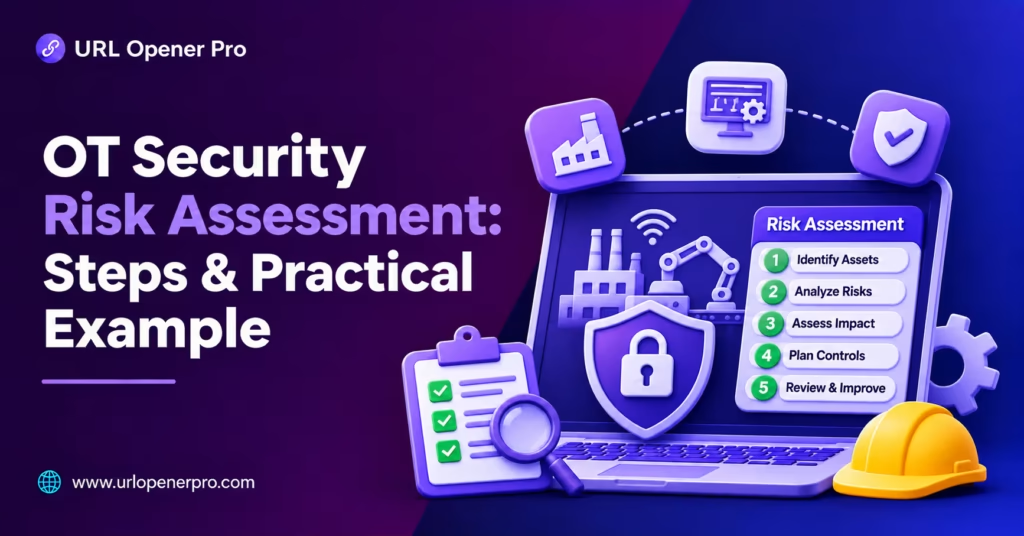
Somebody has just told you, probably a manager or an auditor, that the plant needs a risk assessment for OT security. You have a network diagram that was last accurate in 2019, a vendor who dials in when something breaks, and no clear idea where to start.
Most guides answer that with theory. This one follows an example from start to finish, because that is the quickest way to see how the risk assessment process actually works on a real site.
The Example: A Small Water Pumping Station
To keep things concrete, imagine a municipal water pumping station. It is an illustration, not a real client, but the pattern holds for factories, substations and pipelines too.
The station has two pumps driven by a PLC, a chlorine dosing unit, an HMI in a small control room, and a cellular modem that lets an integrator log in remotely. A historian copies data to the utility’s office network every few minutes.
It is small enough to follow, and it already contains the three things that cause most OT security incidents: a remote path, a link to IT and equipment nobody wants to touch.
Start With the Worst Day, Not the Network
IT teams often start by listing vulnerabilities. In OT, begin with a different question: what is the worst thing this process could do to someone?
Sit with the operators and the process engineer for an hour and ask it directly. For the pumping station, the answers come quickly:
- The dosing unit overfeeds chlorine, and treated water becomes unsafe
- Both pumps stop during peak demand, and pressure drops across the network
- A pump is forced to run against a closed valve until it is damaged
- Operators lose their screen and cannot see what is happening
Notice that none of these mention malware. They describe outcomes. Each one becomes a consequence scenario, and every later step ties back to them. This is the main idea behind consequence-driven approaches to industrial security: work from what matters physically, then ask how an attacker could reach it.
If your site already has process hazard studies such as HAZOP, borrow from them. They list how the process can fail. Your job is to add how a person with bad intent could trigger the same failure.
Build the Asset List You Can Trust
Now you need to know what you are protecting. A usable list for the pumping station includes:
PLC model, firmware version and which network ports are active. HMI computer, operating system and who uses it
The cellular modem and the integrator’s remote access account
The historian link to the office network. Switches, any wireless gear and USB or laptop connections used by maintenance
Backups: do they exist for the PLC logic, and when was one last restored?
Two practical points. First, walk the site. Drawings lie, and a surprising amount of equipment is added without being recorded. Second, prefer passive discovery. Many industrial devices behave badly when they are scanned, so listening to traffic on a mirrored switch port is safer than probing.
Draw the Boundaries: Zones and Conduits
IEC 62443 asks you to group assets with similar security needs into zones and to describe the conduits between them. For our station:
- Zone A: PLC, pumps and dosing controller
- Zone B: HMI and control room equipment
- Conduit 1: the modem and remote access path into Zone B
- Conduit 2: the historian link to the corporate network
This simple map is surprisingly revealing. In the example, the remote access path lands directly on the HMI, which can talk to the PLC. One stolen password on that path reaches the chlorine dosing logic. Nothing in the layout slows an attacker down.
Rate the Risk With a Scale You Can Defend
Now you combine consequence with how plausible and reachable the scenario is. A basic 1 to 5 scale is enough, as long as you write down what each number means. For consequence, for example:
- 5: possible harm to people or the public
- 4: serious environmental or equipment damage
- 3: extended outage
- 2: short outage
- 1: minor effect
For likelihood, consider how exposed the path is, how weak the controls are and how attractive the target is. Multiplying gives a score, but do not treat the number as science. Its job is to sort scenarios so you can talk about them sensibly.
Here is what one line of the risk register might look like for the pumping station:
Scenario: attacker uses stolen integrator credentials to change the chlorine dosing setpoint
Consequence: 5, since unsafe water could reach customers
Likelihood: 4, because remote access has a single password, no second factor and no session logging
Rating: high
Treatment: enforce multi-factor authentication, route access through a jump host, record sessions, add alarm limits on dosing that a setpoint change cannot override
Owner and date: the operations manager, within 60 days
That last pair matters more than people expect. A risk with no owner and no date tends to stay on the list for years.
Choose Treatments That Fit the Plant
Not every fix is a patch. On equipment that cannot be taken offline, treatment usually means:
Segmenting the remote access path and removing direct internet exposure
Adding authentication and logging where the device cannot do it natively. Hardwired safety limits, so a software change cannot push the process past a safe boundary
Monitoring the OT network passively so unusual commands get noticed
Offline, tested backups of controller logic. A written plan for running the pumps manually if the HMI is lost
The hardwired limits point deserves a second look. Good engineering controls reduce the damage of a cyber event whether or not the attacker is ever detected.
What a First Assessment Usually Turns Up
Expect the findings to be dull rather than dramatic, and that is useful. In its 2026 year in review, Dragos reported substantial visibility and monitoring deficiencies in 46% of the architecture reviews it performed, elevated remote access findings in 49% of its service reports and internet-facing systems in 53%. The same report found ransomware stayed in OT environments for 42 days on average before it was contained, while organizations with strong OT visibility did it in about five.
Those numbers line up with the pumping station: remote access, weak boundaries and little visibility. If your first assessment finds the same three, you are not behind. You are normal, and now you can fix them in order.
Where the Standards Fit
You do not have to invent a method.
IEC 62443-3-2 is the industrial standard for security risk assessment. It describes an initial high-level assessment, partitioning into zones and conduits, and a detailed assessment that sets target security levels. The worked example above follows that shape.
NIST SP 800-82 Revision 3, published in 2023, is the US guide to securing OT, and NIST SP 800-30 covers general risk assessment process. They pair well with IEC 62443.
Pick one as your primary method so results stay consistent, then cross-reference the others if an auditor or customer requires it.
Questions That Come Up in Every Workshop
Can we just run a vulnerability scanner?
Not safely on live controllers without a plan. Use passive monitoring in production and run active tests in a lab or during approved windows.
How often should we repeat the assessment?
Review it at least yearly and after any significant change, such as new equipment, a new vendor connection or an incident.
Do we need a consultant?
Not always. A site team with an engineer, an operator and someone from IT security can do a decent first pass. Bring in specialists for larger sites, regulated sectors or when you need independent assurance.
Where to Begin Tomorrow
You do not need a six-month program to start. Gather the operators for an hour, write down the worst day, list what touches it and look hard at every remote path. That one conversation will tell you more about your OT security risk than most scans, and it gives the formal risk assessment something real to build on.