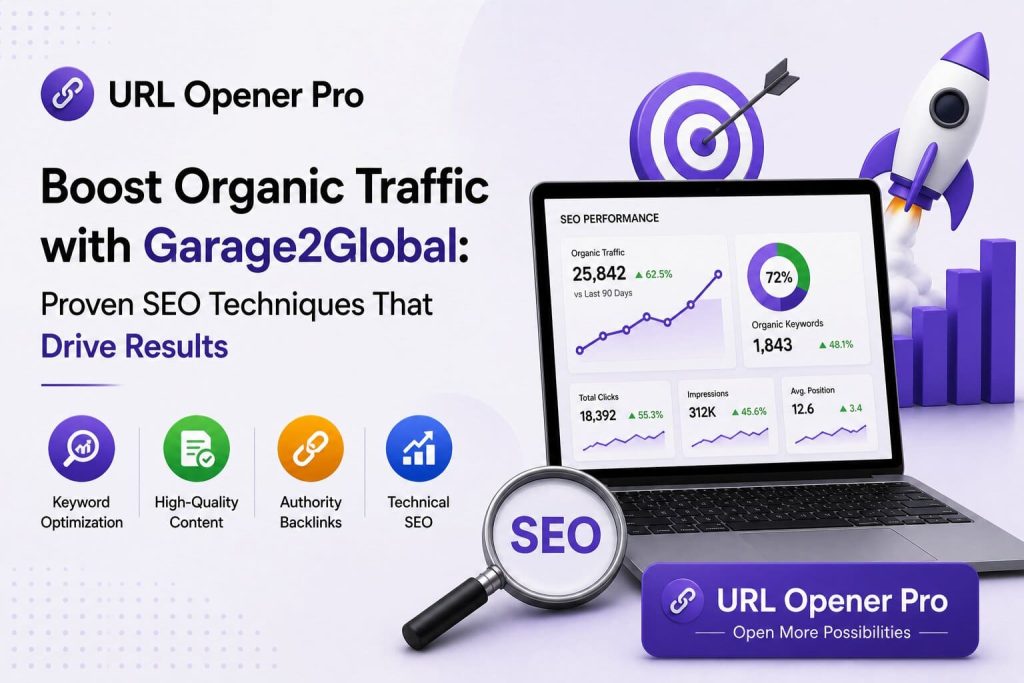
Most businesses chasing organic growth make the same mistake: they treat SEO as a checklist, not a system. They publish content, sprinkle keywords, wait for traffic, and wonder why nothing moves. The hard truth is that organic search rewards systems, not one-off actions. And Garage2Global, as a growth platform for scaling businesses, is built around exactly that logic.
If you want to boost organic traffic with Garage2Global, the starting point is not picking the right tool. It is understanding which SEO levers actually move rankings and how Garage2Global’s framework is designed to support each of them. I have worked with brands that grew from zero domain authority to 200K+ monthly organic visits, and the difference between the ones that succeeded and the ones that stalled was always the same: they followed a repeatable system instead of scattered tactics.
This article breaks down that system in the context of Garage2Global, covering keyword strategy, technical foundations, content architecture, and authority building. Each section gives you something you can act on immediately, not theory you have to figure out how to apply.
How to Boost Organic Traffic with Garage2Global Using Smart Keyword Strategy
Keyword research is where most SEO efforts lose before they start. The default approach: find keywords with high search volume, write content, publish. The problem is that high-volume keywords are usually dominated by brands with 10x your domain authority, and ranking for them in the next 6 months is not realistic. Garage2Global’s methodology flips this by targeting what I call the “winnable middle”: keywords with real commercial intent, moderate difficulty, and topical relevance to your core offering.
Start with search intent before volume.
A keyword like “SEO strategy” gets 12,000 monthly searches in Ahrefs, but the intent is split between people researching basics and people looking to hire. A keyword like “SEO strategy for SaaS startups” has 500 searches per month, but everyone searching it knows what they want. That second keyword converts at 3x to 5x the rate. Always classify intent first: informational, commercial, navigational, or transactional.
Use Ahrefs Keywords Explorer or Semrush Keyword Magic Tool.
Filter by Keyword Difficulty below 25 if your site is under DR 40. Look at the SERP for each keyword before targeting it. If the top 5 results are all major publications or enterprise brands with thousands of backlinks, that keyword is not yours yet. If you see a mix of small blogs, community pages, and mid-authority sites, you have a realistic shot.
Map keywords to the buyer journey.
Garage2Global businesses typically operate in competitive verticals. The keyword map should include top-of-funnel informational terms (blog content, guides), mid-funnel comparison terms (vs. pages, alternative pages), and bottom-of-funnel transactional terms (service pages, pricing pages). Each category needs different content formats and different optimization priorities.
One pattern I use in content strategy work: build a “seed topic” list of 10 to 15 core themes your business owns, then expand each theme into 30 to 50 keyword variants. This gives you a map of 300 to 750 keywords to target over 12 to 18 months. It sounds like a lot. The businesses that do this systematically are the ones sitting at 100K monthly visitors two years later.
Boost Organic Traffic with Garage2Global by Fixing What Google Cannot Crawl
You can have the best content in your niche and still not rank. If Google cannot crawl and index your pages efficiently, everything above this section is irrelevant. Technical SEO is the foundation, and most growing businesses have 3 to 5 critical issues quietly suppressing their organic potential.
Crawl budget waste is the first thing to audit
If your site has URL parameters, duplicate content from faceted navigation, session IDs in URLs, or thin pages that should not be indexed, Google is spending its crawl budget on pages you do not want ranked instead of the ones you do. The fix: use Google Search Console’s “Crawl Stats” report to see what Google is actually crawling. Then implement a combination of canonical tags, noindex directives, and disallow rules in robots.txt to redirect crawl budget toward your high-value pages.
Core Web Vitals are a ranking signal and a conversion signal
Google’s Page Experience update made Largest Contentful Paint (LCP), Interaction to Next Paint (INP), and Cumulative Layout Shift (CLS) ranking factors. Target LCP under 2.5 seconds, INP under 200 milliseconds, and CLS under 0.1. Run Google’s PageSpeed Insights on your 10 most important pages. The fix for LCP is almost always image optimization and server response time. The fix for CLS is almost always setting explicit dimensions on images and reserving space for ads or embeds.
Internal linking architecture determines which pages inherit PageRank
Most sites have a homepage with a healthy backlink profile and interior pages with almost none. The fix is intentional internal linking: every new blog post should link to at least 2 to 3 service or category pages, and your service pages should link to supporting content. Use Screaming Frog to map your current internal link structure. Pages with zero internal links are orphan pages. Google treats them as low-priority.
HTTPS, mobile indexing, and structured data are table stakes
If your site is not fully on HTTPS, fix it before anything else. If your mobile experience breaks layout or hides content behind JavaScript that Google cannot render, your pages are indexing as empty shells. Use Google’s Mobile-Friendly Test and the URL Inspection tool in Search Console to verify what Google actually sees when it crawls your pages.
When I run an SEO audit for clients, these issues show up on 80% of sites regardless of size. The technical pass is not glamorous work, but it is the work that unlocks everything else. If you want a structured way to work through this, my SEO Audit service covers all of this systematically.
Boost Organic Traffic with Garage2Global Through Topical Authority Content
Google’s Helpful Content system, combined with the emphasis on Experience, Expertise, Authoritativeness, and Trust (E-E-A-T), means that publishing isolated blog posts is less effective than it used to be. What Google rewards now is topical authority: the signal that a website covers a subject deeply and comprehensively, not just at the surface level.
Build content clusters, not content calendars
A content calendar asks “what do we publish this month?” A content cluster asks “what is the complete map of questions a person has on this topic, and do we have a page answering each one?” The cluster model works like this: one pillar page targets the broad keyword (high-level guide), and 8 to 15 cluster pages target specific sub-topics, each linking back to the pillar. The pillar distributes authority to the clusters. The clusters reinforce the pillar’s topical relevance. Google sees a site that owns a topic, not one that dabbles in it.
The pillar page should be the most complete resource on the topic
Not the longest. The most complete. That distinction matters. Completeness means answering every legitimate sub-question within a single, logically structured page. Use Surfer SEO or Clearscope to audit what the top-ranking pages cover and identify gaps. Every gap is content the reader still has to search for elsewhere after reading your page. Fill them.
First-hand experience signals matter more than ever
Google’s E-E-A-T guidelines explicitly call out Experience as a ranking quality factor. Content that includes original data, personal case studies, specific tool outputs with real screenshots, or documented results from real projects performs better than generic guides assembled from other articles. If you have run an SEO campaign that produced a 3x traffic increase, that specific result belongs in your content. If you have used a tool and can show what it actually produces, that specificity earns trust both from readers and from Google’s quality evaluators.
Publish, measure, and iterate
Content does not rank immediately. Most pages take 3 to 6 months to reach their ranking ceiling. After publishing, wait 90 days, then analyze in Google Search Console: which queries is the page appearing for? Which have an average position between 5 and 20? Those are your optimization targets. Improve the section of the page that addresses that query. Add a more specific H3. Improve the answer-first paragraph. That cycle, repeated across your content library, is what compounds into serious traffic over 12 to 24 months.
Boost Organic Traffic with Garage2Global by Building Backlinks That Actually Move Rankings
Backlinks remain one of Google’s strongest ranking signals. The reason is simple: a backlink from an authoritative, relevant website is a vote of confidence that cannot be easily faked at scale. What has changed is the type of backlinks that move rankings. Generic directory links, low-quality guest posts on unrelated sites, and link farms actively hurt rather than help. The links that work in competitive search results are earned, relevant, and contextual.
Digital PR is the highest ROI link building strategy for growing businesses
The mechanism: create original research, a data study, a proprietary survey, or a unique tool. Pitch it to journalists and writers who cover your industry. When they cite it, they link back to the source. One well-executed campaign can produce 30 to 80 editorial links from publications with DR 50 to 90 in a single month. That kind of velocity is what separates flat organic growth curves from sharp upward ones.
Guest posting still works when it is selective
The difference between guest posting that helps and guest posting that does not: topical relevance of the host site, the authority of the specific page you link from (not just domain authority), and whether the anchor text is varied and natural. A guest post on a DR 55 marketing blog with 2,000 monthly organic visitors in your niche is worth more than a generic business blog with DR 70 and zero topical relevance to your industry.
The Skyscraper Technique produces consistent results
Find content in your niche that has earned 50 or more backlinks. Build a better version: more depth, more current data, original examples, better formatting. Then reach out to every site linking to the original and show them yours. Response rates of 5 to 10% are normal. At scale, this compounds. I cover this in depth in my link building service if you want a done-for-you approach.
Broken link building is underused and effective
Use Ahrefs Site Explorer to find resource pages in your niche. Filter for broken outbound links using the Broken Links report. When you find a broken link pointing to a page your content could replace, reach out to the site owner with the broken link flagged and your resource as a replacement. Conversion rate on these outreach campaigns is consistently higher than cold pitching because you are solving a problem for them, not just asking for something.
Monitor your backlink profile monthly
Toxic links from low-quality sites, link schemes, or hacked directories can trigger a manual penalty or algorithmic suppression. Use Ahrefs or Google Search Console’s Links report to spot unusual spikes or patterns. Disavow files are your last line of defense, not your first. Clean link hygiene is easier to maintain than it is to recover from after damage.
Conclusion
Organic traffic growth is not a sprint. Every site I have grown past the 100K monthly visitor mark got there through the same compounding sequence: precise keyword targeting, a clean technical foundation, content that earns genuine topical authority, and backlinks from sources that carry real PageRank. Garage2Global’s framework gives you the structure to execute each of those pieces without reinventing the wheel at every step.
The next action is specific: run a crawl audit of your site this week using Screaming Frog (free up to 500 URLs) or Google Search Console’s Coverage report. Identify the technical blockers first. Everything you build on a broken foundation gets filtered before it reaches rankings. Start there, then layer in the keyword and content work. That is how you boost organic traffic with Garage2Global in a way that compounds over time.
Frequently Asked Questions
What does it mean to boost organic traffic with Garage2Global?
Boosting organic traffic with Garage2Global means using the platform’s growth-oriented framework to implement SEO strategies that increase the number of visitors arriving at your website through unpaid search results. This includes keyword research, technical SEO fixes, content cluster creation, and backlink acquisition. Garage2Global’s system is designed for scaling businesses that want measurable, long-term search visibility rather than short-term traffic spikes.
How long does it take to see results from SEO with Garage2Global?
Most SEO efforts produce measurable ranking movement within 3 to 6 months, depending on the competitiveness of your target keywords, your site’s domain authority, and how aggressively you are publishing and building links. Highly competitive keywords in industries like finance or SaaS can take 9 to 18 months to reach page one. Lower-competition niches can see page-one results in 60 to 90 days. The technical fixes and content infrastructure you put in place in months 1 and 2 are what make months 6 through 12 productive.
What types of keywords should I target to boost organic traffic with Garage2Global?
Target keywords based on a combination of search intent, keyword difficulty, and business relevance. If your site has a Domain Rating (DR) below 40, focus on keywords with a difficulty score under 25 in Ahrefs or Semrush. Prioritize commercial and transactional keywords for your core service or product pages, and informational keywords for your blog content. Build from the easiest, most specific long-tail terms first and work toward broader head terms as your domain authority grows.
Is content volume or content quality more important for SEO growth?
Quality wins, but quality alone is not enough without consistency. A single well-researched pillar article that earns backlinks can drive more traffic than 20 thin blog posts. That said, topical authority requires covering a subject comprehensively across multiple pages, so consistent publication within a focused topic cluster is what produces compounding results. Publish fewer pieces at higher quality, at a frequency you can sustain, rather than flooding your site with mediocre content.
How do backlinks affect organic traffic when using Garage2Global?
Backlinks pass PageRank from external sites to your pages, which signals authority to Google and directly influences rankings. More rankings across more keywords means more organic clicks. A site with 500 high-quality backlinks from relevant domains will consistently outrank a site with 5,000 low-quality backlinks, because Google has become effective at detecting link manipulation. Focus on editorial links from topically relevant, authoritative sites through digital PR, guest posting, and the Skyscraper Technique.
What technical SEO issues most commonly suppress organic traffic?
The most common suppressors are: pages blocked from indexing by mistake in robots.txt or through noindex tags, duplicate content from URL parameters or www vs. non-www variations, slow page speed (LCP over 2.5 seconds), broken internal links, missing canonical tags, and thin pages that dilute crawl budget. Run Google Search Console’s Coverage and Core Web Vitals reports monthly to catch these issues early. Screaming Frog is the most efficient tool for a comprehensive site-wide technical crawl.
Can I boost organic traffic without building backlinks?
Yes, but with significant limitations. In low-competition niches with minimal established authority, well-optimized content alone can rank for informational keywords. However, for competitive commercial keywords where multiple well-funded sites are competing, backlinks are the differentiating factor. Sites that rely entirely on content without link acquisition plateau at a certain traffic level and cannot push past it without authority signals from external sources.
How does topical authority help boost organic traffic with Garage2Global?
Topical authority signals to Google that your site is a definitive resource on a subject, not just a page that mentions the topic. When you cover a topic across a pillar page and 10 to 15 cluster articles, each internally linked, Google’s algorithms begin to associate your domain with that subject area. This leads to higher rankings across the entire cluster, not just the pillar page. Over time, new content in the same topic cluster ranks faster because the domain already carries topical trust.
What is the role of Core Web Vitals in organic traffic growth?
Core Web Vitals (LCP, INP, and CLS) are a confirmed Google ranking factor under the Page Experience system. A page that fails Core Web Vitals competes at a disadvantage against equally relevant pages that pass. Beyond rankings, page speed and stability directly impact bounce rate and conversion rate, so improving Core Web Vitals has both an SEO effect and a user experience effect. Use Google PageSpeed Insights and the Core Web Vitals report in Search Console to identify which pages need attention.
How do I measure whether my SEO efforts with Garage2Global are working?
Track three primary signals: organic sessions (Google Analytics 4), keyword rankings across your target list (Ahrefs or Semrush rank tracker), and impressions plus click-through rate in Google Search Console. Set a monthly review cadence. Positive trends in impressions before clicks is normal, because rankings improve before click-through rates do. A healthy content and link program should show measurable ranking improvements across your target keyword list within 90 days and consistent organic session growth from month 4 onward.
What is the biggest mistake businesses make when trying to boost organic traffic?
Targeting keywords that are too competitive for their current domain authority. A DR 20 site targeting “digital marketing strategy” (KD 85) will see no results for 18 to 24 months even with good content. The same site targeting “digital marketing strategy for local service businesses” (KD 15) can hit page one in 60 days. The faster early wins are what build the domain authority needed to compete for harder keywords later. Skipping this phase costs time and budget.