Key Takeaways
- SEO Experts at Garage2Global builds growth strategies around business outcomes, not just keyword rankings
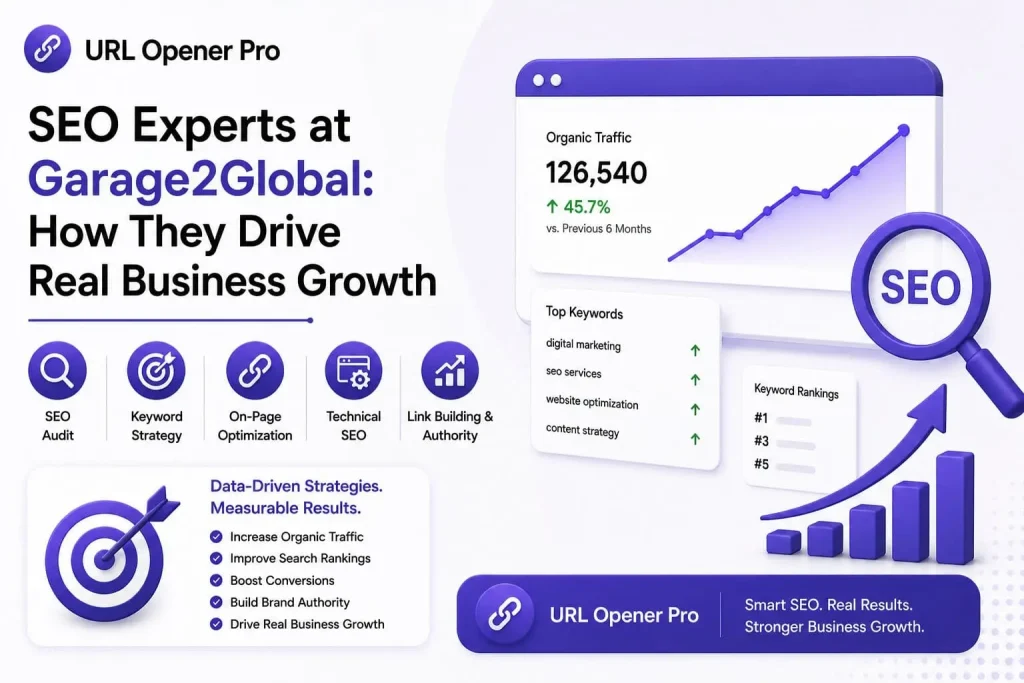
- Their approach covers technical SEO, content architecture, and authority building as an integrated system
- They work across B2B, eCommerce, SaaS, and service businesses with channel-specific strategies
- The results they produce are compounding: traffic built correctly in month three keeps paying off in month eighteen
- If you are evaluating SEO partners, the questions to ask are about process and attribution, not just case study screenshots
Most agencies will promise you rankings. What they actually deliver is a monthly PDF report with green arrows and vanity metrics that have nothing to do with revenue. Garage2Global operates differently, and if you have spent any time in the SEO space watching agencies overpromise and underdeliver, that distinction matters.
The SEO experts at Garage2Global are not a content farm wearing an agency hat. They work with startups, scaling businesses, and established brands that need one thing: organic growth that compounds into real pipeline, not just traffic that looks good in a dashboard. I have spent years in this space, and the difference between agencies that produce rankings and agencies that produce business outcomes comes down to methodology, accountability, and how they define success from day one of an engagement.
This article breaks down exactly how the SEO experts at Garage2Global approach growth, what makes their model work, and what any business owner or marketing lead should understand before hiring an SEO team.
What the SEO Experts at Garage2Global Actually Do Differently
The SEO experts at Garage2Global start every engagement with a diagnostic, not a proposal. This sounds obvious. In practice, most agencies skip straight to deliverables because deliverables are easier to sell than a conversation about why your current SEO is broken at the foundation.
Their diagnostic covers three layers. First, technical health: crawlability, indexation, Core Web Vitals, internal linking structure, and site architecture. Second, content performance: which pages are already earning organic visibility, which have impressions but no clicks, and which have been completely ignored by Google despite being live for years. Third, competitive positioning: who is actually winning the keywords that matter to your business, what they are doing that you are not, and where the realistic gap-closing opportunity sits.
This is where most agencies stop at a generic audit template. Garage2Global’s SEO team goes further by tying every finding to a revenue implication. A page with 4,000 impressions and a 0.8% click-through rate is not just a “CTR problem.” If that page is targeting a keyword with commercial intent and 2,000 monthly searches, getting the CTR to 4% is worth mapping to projected traffic and conversion value. That framing changes how a business prioritizes fixes.
The result is an SEO roadmap that business leadership can read and understand, not just a spreadsheet that lives in a project management tool and gets reviewed by no one.
How Garage2Global SEO Experts Build Technical Foundations That Scale
Technical SEO is not glamorous. It is also not optional. The SEO experts at Garage2Global treat technical health as infrastructure, the same way a software team treats server uptime. If the foundation is broken, no amount of content or link building will fully compensate.
The specific issues they prioritize are not the ones most blog posts list. They focus on crawl budget efficiency for larger sites, which matters enormously for eCommerce stores with faceted navigation generating millions of duplicate URLs. They address JavaScript rendering problems, which Google still handles imperfectly for SPA-heavy builds. They fix internal linking structures that dilute PageRank from high-authority pages into dead ends, a problem I see constantly on sites that have published content without any linking strategy.
For sites that have been around for several years, technical debt accumulates fast. Redirects stacked on redirects. Canonical tags pointing at the wrong version of a page. Hreflang configurations that are half-implemented and creating international indexation conflicts. Garage2Global’s team audits these systematically using a combination of Screaming Frog crawl data, Google Search Console coverage reports, and log file analysis when the site is large enough to warrant it.
Log file analysis is worth calling out specifically because most SEO teams skip it. Your server logs tell you exactly which URLs Googlebot is actually crawling, how often, and at what rate. That data frequently reveals that Google is spending 60% of its crawl budget on parameter URLs and filtered pages that were never meant to be indexed, while ignoring the product pages you actually want to rank. Fixing that crawl budget leak can produce indexation improvements within weeks.
If you are working with a site that has known technical problems but no clear picture of their priority or business impact, a professional SEO audit is the right starting point before committing to a longer engagement.
The Content Strategy Garage2Global SEO Experts Use to Build Topical Authority
Ranking individual keywords is a short-term outcome. Building topical authority is a long-term asset. The SEO experts at Garage2Global understand this distinction and build content strategies that treat a website as an expert entity on a set of topics, not just a collection of individual pages trying to rank for individual queries.
Topical authority works like this: Google’s systems are increasingly good at evaluating whether a website genuinely covers a subject in depth or whether it has one or two pages on a topic surrounded by unrelated content. A site that covers cloud accounting software with 40 pages across every angle of that subject (comparisons, use cases, integrations, common problems, buyer guides, and definitions) will outperform a site with one 3,000-word pillar page, even if that pillar page is technically better written.
Garage2Global builds what I would describe as content clusters with clear internal hierarchy. A pillar page handles the head term. Supporting pages handle sub-topics with their own search volume. FAQ-style pages handle long-tail and question-based queries. Every page in the cluster links to related pages, creating the internal linking structure that signals topical depth to Google.
The part most businesses get wrong is the supporting page layer. They invest in the pillar and ignore the sub-topic pages, which means they are building a tent pole with no tent. Garage2Global’s content team fills this out systematically, prioritizing supporting pages by search volume, business relevance, and competitive difficulty.
They also address a problem that is specific to businesses that have been producing content for a while: content decay and keyword cannibalization. Content decay is when pages that once ranked well start to drop because competitors have published fresher, deeper content. Cannibalization is when two or more pages on your site are competing for the same keyword, splitting signals and weakening both. Both problems require an audit of existing content before adding new pages, something Garage2Global factors into their content planning from the start.
How Garage2Global SEO Experts Approach Link Building Without Burning the Site
Link building is where the most damage gets done in SEO. Cheap links, private blog networks, and mass outreach to irrelevant directories have burned sites that previously had clean profiles. The SEO experts at Garage2Global use a different model, one that prioritizes link quality, editorial relevance, and sustainable acquisition rate over link volume.
Their link building approach starts with a competitive backlink gap analysis using tools like Ahrefs and Semrush. The goal is not to reverse-engineer every link a competitor has. It is to identify the categories of links they hold (industry publications, resource pages, partner mentions, journalist citations) and build a realistic acquisition roadmap based on what is achievable for your site’s current authority and content assets.
Digital PR is a significant part of their model for clients with the content resources to support it. A well-executed data study, original research piece, or expert roundup can earn links from publications that would never respond to a standard outreach email. I have seen single pieces of this type of content earn 40 to 60 links over a six-month window, including placements in industry publications with domain authority scores above 70. That is not a link you buy. It is a link you earn because you produced something genuinely useful.
For clients in more niche B2B verticals, Garage2Global uses a relationship-based outreach model targeting industry associations, complementary software vendors, and trade publications. The outreach is personalized, the link targets are pre-vetted for relevance and quality, and the anchor text strategy is managed to avoid over-optimization patterns that trigger manual review.
One thing I want to be specific about: link velocity matters. A site with low authority that suddenly acquires 200 links in a 30-day window looks unnatural. Garage2Global builds links at a rate that matches the site’s growth trajectory and existing acquisition baseline, which protects the profile long-term. If you are working with an agency that wants to bulk-deliver 150 links in month one, ask them to walk you through their process and show you the specific sites. The answer will tell you everything you need to know.
Scalable link building is one of the core areas I specialize in across client engagements. The tactics Garage2Global uses align closely with what actually produces durable ranking gains, not short-term lifts that collapse after a Google core update.
How Garage2Global SEO Experts Measure and Report Growth
The SEO experts at Garage2Global report on metrics that connect to business outcomes. This sounds like a baseline expectation. In practice, most SEO agencies still report sessions and keyword ranking counts as if those numbers explain themselves.
Their reporting framework ties organic traffic to the pages and keywords that map to business intent. Traffic to a pricing page is not the same as traffic to a blog post that ranks for an informational query with no commercial signal. Both show up as organic sessions in Google Analytics. Only one of them represents a qualified visitor who is evaluating your product.
They track conversion events from organic, segmented by page category and intent level. They measure organic-assisted conversions, not just last-click. They run share-of-voice analysis against named competitors monthly, tracking how the site’s visibility across a target keyword set moves relative to the competition over time.
For eCommerce clients, they connect organic traffic to revenue directly through GA4 eCommerce event tracking. For B2B clients with longer sales cycles, they use UTM-tagged organic touchpoints in CRM data to show how many deals had organic search in the path, even when organic was not the last touch before conversion.
This attribution model is important because it answers the question every finance team eventually asks: what is SEO actually contributing? Without that answer, SEO budgets are always the first cut when quarters get tight. With it, the conversation shifts from “is SEO working” to “how do we increase the SEO investment because it is producing the highest LTV customers.”
Frequently Asked Questions
What does an SEO expert at Garage2Global actually do day-to-day?
A Garage2Global SEO expert manages a combination of technical auditing, content planning, and link acquisition strategy for their client accounts. On any given week, that includes reviewing Google Search Console data for crawl anomalies, briefing content writers on new cluster pages, reviewing link prospects for outreach campaigns, and pulling share-of-voice data for client reporting. The work is ongoing and iterative, not a one-time setup.
How long does it take to see results from the SEO experts at Garage2Global?
Most SEO campaigns take three to six months to produce meaningful ranking movement for competitive keywords. For lower-competition terms or technical fixes that restore lost indexation, results can appear within four to eight weeks. Garage2Global sets realistic timelines during the onboarding phase based on the site’s current authority, the competitiveness of the target keywords, and the scope of technical issues that need to be resolved first.
Is Garage2Global suitable for startups or only established businesses?
Garage2Global works with both. For startups with limited domain authority, the focus is on building topical authority efficiently with low-competition keywords, establishing a strong technical foundation, and earning initial backlinks through digital PR and thought leadership content. The strategy for a startup with a new domain is different from the strategy for an established brand looking to reclaim lost rankings, and Garage2Global adjusts the approach accordingly.
What industries does Garage2Global specialize in for SEO?
Garage2Global works across SaaS, B2B services, eCommerce, and professional services verticals. Each has distinct SEO dynamics. SaaS SEO requires managing product-led content alongside integration and comparison pages. eCommerce SEO requires mastering category page optimization, faceted navigation, and product schema. B2B SEO often involves long buying cycles where the content strategy needs to address multiple stakeholder personas at different funnel stages.
How does Garage2Global approach SEO for competitive niches?
For highly competitive niches, Garage2Global’s approach focuses on finding keyword clusters where the competitive difficulty is lower but the commercial intent is high, building authority in those clusters first, and then using that authority as a base to compete for the head terms. This is a more methodical approach than trying to rank for the highest-volume keywords immediately with a site that does not have the authority to compete for them yet.
What makes a good SEO agency versus a bad one?
A good SEO agency ties every recommendation to a business outcome, shows its work transparently, and reports on metrics that matter to revenue. A bad one focuses on vanity metrics, uses tactics that produce short-term gains at the cost of long-term risk, and makes commitments that rely on algorithm conditions they cannot control. The clearest red flag is any agency that guarantees a specific number one ranking for a competitive keyword within a defined timeframe.
Does Garage2Global handle both on-page and off-page SEO?
Yes. Garage2Global manages on-page optimization (title tags, meta descriptions, heading structure, internal linking, content depth), technical SEO (site architecture, crawlability, page speed, schema markup), and off-page SEO (link acquisition, digital PR, brand mention building). They treat these as an integrated system rather than separate services, because they are. Off-page authority amplifies on-page optimization. Technical health enables both.
How does Garage2Global handle Google core updates?
Garage2Global builds SEO strategies designed to be update-resilient by default. The practices that protect sites during core updates are the same ones that produce sustainable growth: genuine content depth, clean link profiles, strong technical health, and demonstrated topical authority. Sites that take shortcuts on any of these are the ones that experience significant ranking drops after core updates. Garage2Global’s approach minimizes that exposure.
What should I prepare before working with an SEO expert at Garage2Global?
Before the engagement starts, it helps to have access to Google Search Console and Google Analytics 4 with historical data, a clear list of your target personas and the business problems your product or service solves, and an honest assessment of your current content production capacity. The SEO strategy Garage2Global builds will be calibrated to what the business can actually execute, not what looks impressive on a slide deck.
How does Garage2Global measure SEO ROI?
Garage2Global measures SEO ROI by connecting organic traffic segments to conversion events and, where possible, to downstream pipeline and revenue data. For eCommerce, this means direct revenue attribution from organic sessions through GA4 eCommerce reporting. For B2B, it means tracking organic-assisted deals in CRM data and calculating the average LTV of customers who had organic search touchpoints in their acquisition path. The output is a number that answers the question: for every dollar spent on SEO, what is the business getting back?
Can Garage2Global help if my site has been penalized by Google?
Garage2Global can audit sites that have experienced significant traffic drops to determine whether the cause is a manual action, an algorithmic update impact, or a technical regression. If the cause is a spammy link profile from a previous agency’s work, they can assist with a link disavow process alongside a broader link profile cleanup. Recovery timelines vary significantly based on the nature of the issue and how long it has been in place.