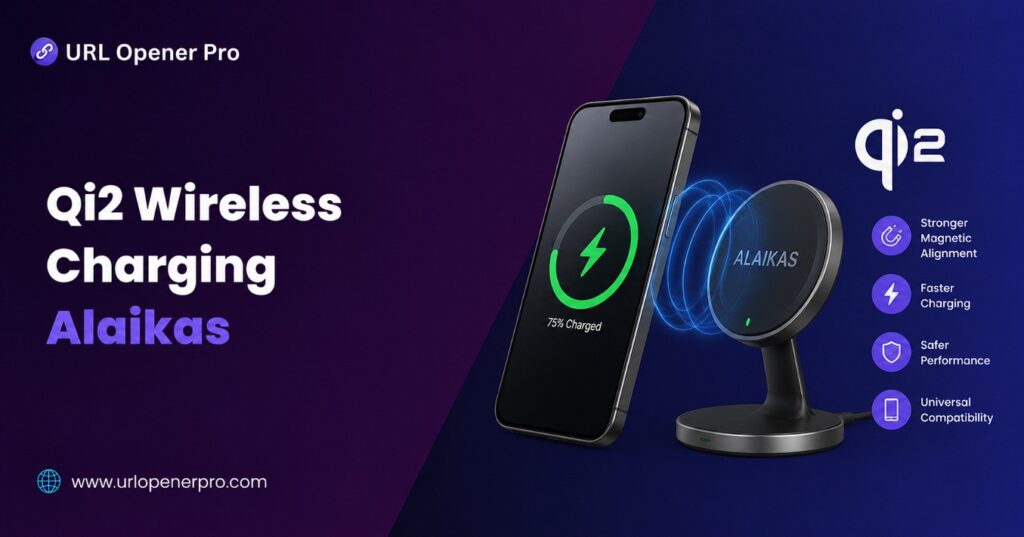
Wireless charging has been around long enough that it should feel effortless by now. For most people, it still doesn’t. You set your phone down, wander off, and come back to find it at 34% because it drifted two millimeters off-center. That specific frustration is exactly what Qi2 wireless charging Alaikas is built to fix.
Qi2 is the second-generation wireless charging standard from the Wireless Power Consortium, and “Alaikas” refers to the refined implementation of that standard in a class of chargers built around precision, magnetic alignment, and reliable everyday performance. This guide breaks down how the technology actually works, what’s genuinely better about it, which devices support it, and what to expect when you switch.
How Qi2 Wireless Charging Alaikas Works (The Technical Part Made Simple)
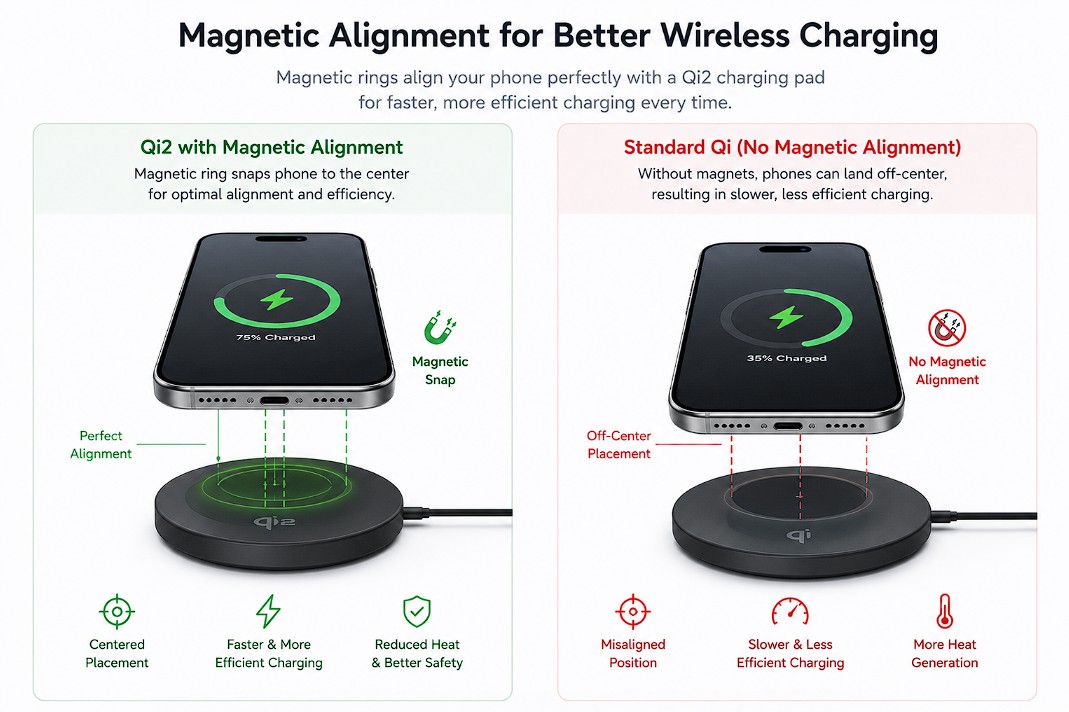
The biggest problem with original Qi charging wasn’t the technology itself. It was alignment. A misalignment of even 2 to 3 millimeters forces the magnetic field to bridge a gap it wasn’t designed for. That wasted energy becomes heat. Heat triggers thermal throttling. Charging slows down to protect the battery, and you end up waiting twice as long for half the charge.
Qi2 solves this with the Magnetic Power Profile (MPP). A ring of magnets surrounds the charging coil, and when you place a Qi2-compatible device on a Qi2 charger, those magnets snap the device into perfect position automatically. No guessing. No adjusting. The coils line up precisely every time.
Once aligned, the charger and device negotiate digitally. The charger asks what the device needs; the device reports its battery state, temperature, and current draw; and the charger adjusts power delivery accordingly. This is why Qi2 charges without the heat spikes that plagued older wireless pads. It’s not just faster, it’s smarter.
The origin of this approach is worth knowing. Apple developed the magnetic alignment concept for MagSafe in 2020 and later contributed the underlying technology to the Wireless Power Consortium. The WPC built it into an open, universal standard that any manufacturer can implement. That decision is why Android phones can now use the same magnetic chargers as iPhones, at the same speeds, without any proprietary hardware.
The Real Benefits of Qi2 Wireless Charging Alaikas Over Standard Qi
Speed is the obvious headline, but it’s not the whole story. Here’s what actually changes when you move from an older Qi charger to a Qi2 wireless charging Alaikas setup.
Charging speeds. Original Qi topped out at 5W for most devices, with extended power profile (EPP) bringing it to 7.5W for iPhones and up to 15W for some Android phones under specific conditions. Qi2 delivers a consistent 15W across all certified devices, not conditionally, not depending on which firmware version your phone is running. The Wireless Power Consortium confirmed that Qi2 25W (also called Qi2.2) pushes this further, charging a smartphone from 0 to 50% in roughly 30 minutes.
Heat management. Because the coils are always aligned, the charger doesn’t need to compensate for inefficiency by pushing more current. Less wasted energy means less heat. Less heat means the battery spends less time throttled and more time actually charging.
Reliability. With older pads, you could wake up to a phone that stopped charging because a notification made it vibrate sideways at 2am. Qi2’s magnetic attachment holds the device in position. That click-into-place feeling isn’t just satisfying, it’s functional.
Battery longevity. Charging to 80% repeatedly at lower heat produces less battery degradation over time than slow, inefficient charging that runs hot. Qi2’s thermal management directly affects how long your battery holds capacity over two or three years.
Backward compatibility. Qi2 chargers still work with older Qi devices. They just can’t deliver 15W to a device that doesn’t support the standard. If you upgrade your charger before your phone, it still works.
Qi2 Wireless Charging Alaikas vs. MagSafe and Original Qi: What’s Actually Different
The comparison that comes up most often is Qi2 vs. MagSafe. Since Qi2 is literally based on Apple’s MagSafe technology, it’s a fair question.
MagSafe is Apple’s proprietary implementation. It works at 15W on iPhones (12 and later) and uses the same magnetic ring concept. MagSafe chargers are Apple-certified only. Third-party manufacturers can make Qi2 chargers but cannot call them “MagSafe” without Apple certification, which adds cost and exclusivity.
Qi2 is the open version. Any WPC-certified manufacturer can build a Qi2 charger. This means more options, lower prices, and cross-platform compatibility. An iPhone 15 and a Samsung Galaxy S24 can both charge at full speed on the same Qi2 pad, something that was impossible before.
Original Qi is the baseline. It works, it’s widely supported, and it’s cheap. But it doesn’t have magnetic alignment, it can’t guarantee 15W across devices, and it runs hotter.
Here’s a simple comparison:
| Standard | Max Speed | Magnetic Alignment | Cross-Platform |
|---|---|---|---|
| Original Qi | Up to 15W (device-specific) | No | Yes (limited speed) |
| MagSafe | 15W | Yes | iPhones only |
| Qi2 | 15W (25W with Qi2.2) | Yes | Yes |
The case for Qi2 over MagSafe is straightforward if you have multiple devices or plan to switch phones without being locked to one ecosystem.
Qi2 Wireless Charging Alaikas Compatibility: Which Devices and Chargers Work
Qi2 compatibility has expanded quickly since the standard launched in 2023. Here’s where things stand.
iPhones: The iPhone 12 through the current lineup support Qi2. Prior to Qi2, iPhones needed Apple-certified MagSafe chargers to hit 15W. With a certified Qi2 charger, you get the same speed at a lower price point.
Android phones: Samsung announced official Qi2 support at CES 2025. Google’s Pixel lineup has been moving toward compatibility as well. Check the spec sheet for any Android phone released after 2024, since support varies by model and region.
Wearables and accessories: AirPods with wireless charging cases, some smartwatches, and wireless earbuds charge at 5W on Qi2 pads. The magnetic alignment doesn’t apply (the magnets are phone-specific), but the standard backward compatibility means they still charge normally.
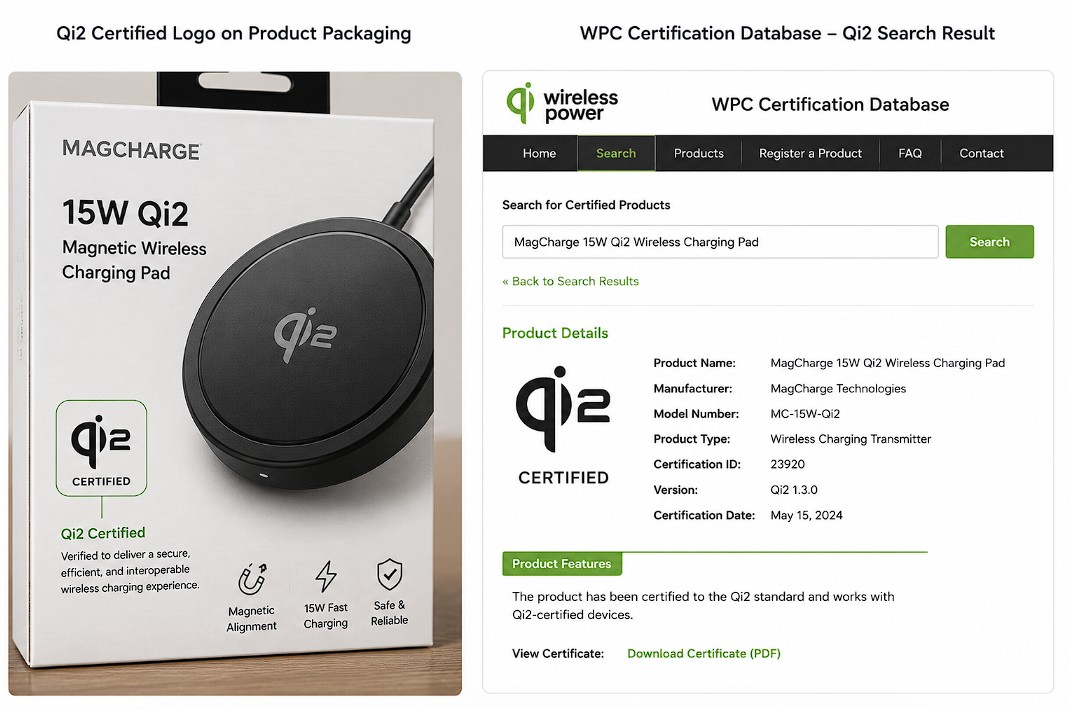
What to look for in a Qi2 charger: The WPC maintains a certified product database. Any charger with a Qi2 logo has passed interoperability and safety testing. Brands including Anker, Belkin, Mophie, and Scosche were among the first to launch certified products at CES 2024.
One thing worth knowing: Qi2 chargers require a USB-C power adapter capable of delivering at least 20W to hit full 15W charging speeds. If you plug a Qi2 pad into a 10W adapter, it won’t charge at 15W. The bottleneck is often the adapter, not the charger.
Setting Up Qi2 Wireless Charging Alaikas: What to Do (and What to Avoid)
Getting the most out of a Qi2 setup doesn’t take much, but a few practical points are easy to miss.
Remove thick cases. Qi2’s magnetic alignment requires physical proximity between the charger’s magnets and the device’s internal magnets. Cases thicker than about 3mm can reduce magnetic force enough to affect alignment. Qi2-compatible cases (often labeled “MagSafe compatible”) are thin enough to let the magnets do their job.
Use the right adapter. As noted above, a USB-C PD adapter rated at 20W or higher is necessary for full-speed charging. The charger itself will usually specify the required input in its documentation.
Place it on a flat surface. Qi2 stands (vertical mounts) work well for overnight charging. Pads work better as grab-and-go solutions. Pick the form factor based on how you actually use your phone while it charges.
Don’t stack devices carelessly. Multi-device Qi2 chargers can handle a phone, earbuds, and a watch simultaneously, but placing a phone over earbuds (or vice versa) without the correct charger layout can cause interference. Chargers designed for multiple devices space the coils intentionally.
Check for firmware updates. Both chargers and phones occasionally receive updates that affect wireless charging performance. If a new charger isn’t hitting expected speeds with a compatible phone, check for pending system updates on both devices.
Conclusion
Qi2 wireless charging Alaikas solves the problem that made wireless charging annoying for years: unreliable placement, inconsistent speeds, and heat. The magnetic alignment alone is a bigger quality-of-life change than most spec-sheet comparisons convey. Place the phone, feel the click, walk away. It charges.
The open standard also matters. Qi2 breaks the MagSafe pricing premium without sacrificing performance, and it works across iPhone and Android on the same hardware. If you’re buying a new wireless charger today, there’s no practical reason to choose one that isn’t Qi2 certified.
The next step is straightforward: check whether your phone is Qi2-compatible, pick up a WPC-certified Qi2 charger from a brand you trust, and pair it with a 20W or higher USB-C adapter.
Frequently Asked Questions
What is Qi2 wireless charging Alaikas?
Qi2 wireless charging Alaikas refers to a next-generation wireless charging approach built on the Qi2 standard developed by the Wireless Power Consortium. It uses a Magnetic Power Profile (MPP), where a ring of magnets snaps a compatible device into perfect alignment with the charging coil, reducing energy loss, heat, and charging inconsistency compared to original Qi.
How fast does Qi2 wireless charging actually charge a phone?
Certified Qi2 chargers deliver 15W to compatible devices. With the newer Qi2.2 (Qi2 25W) standard, speeds reach 25W, which the WPC says is enough to charge a smartphone from 0 to 50% in approximately 30 minutes. Actual speeds depend on the device, adapter, and ambient temperature.
Is Qi2 the same as MagSafe?
No, though they share the same core technology. Apple developed the magnetic alignment system for MagSafe in 2020 and contributed it to the WPC, which built it into the open Qi2 standard. MagSafe is Apple’s proprietary certification with specific licensing requirements. Qi2 is the universal version available to any certified manufacturer, and it works across iPhone and Android devices at the same speeds.
Does Qi2 work with older Qi devices?
Yes. Qi2 chargers are backward compatible with original Qi devices. An older phone without Qi2 support will still charge on a Qi2 pad, just at Qi speeds rather than 15W. You won’t get the magnetic alignment benefits on non-Qi2 phones.
Which iPhones support Qi2 wireless charging?
The iPhone 12 and all models released after it support Qi2. These phones have the internal magnet array required for magnetic alignment. Earlier iPhones can charge on Qi2 pads but only at standard Qi speeds without the alignment feature.
Do Android phones work with Qi2 chargers?
Android support is expanding. Samsung officially announced Qi2 compatibility at CES 2025. Many newer Android devices from other manufacturers also support the standard. Check the device specifications directly, since Qi2 support varies by model even within the same product line.
Does Qi2 damage phone batteries faster than wired charging?
Qi2’s thermal management is designed specifically to reduce battery degradation. Because the charger and device communicate digitally and adjust power delivery based on temperature and charge state, Qi2 typically generates less sustained heat than both older wireless pads and some fast-wired chargers. Lower heat over time means slower long-term battery capacity loss.
What adapter do I need for a Qi2 charger?
A USB-C power delivery (PD) adapter rated at 20W or higher is recommended for full 15W Qi2 charging. Plugging a Qi2 charger into a lower-rated adapter will result in slower charging speeds because the charger can only draw as much power as the adapter provides.
Can I use a Qi2 charger with a phone case on?
It depends on the case. Cases up to about 3mm thick generally allow Qi2’s magnetic alignment to work correctly. Thicker cases or cases with metal components can reduce or block the magnetic connection. Cases specifically labeled as “Qi2 compatible” or “MagSafe compatible” are built to the right thickness.
What is Qi2.2 and is it different from Qi2?
Qi2.2, also called Qi2 25W, is an updated version of the Qi2 standard finalized by the WPC in 2025. It raises the maximum wireless charging speed from 15W to 25W while keeping the same magnetic alignment system. Qi2.2 chargers are backward compatible with original Qi2 and standard Qi devices.
How do I know if a Qi2 charger is actually certified?
Look for the Qi2 logo on the product packaging or in the product listing. The Wireless Power Consortium maintains a searchable certification database on its website where you can verify any charger by brand or model number. Uncertified products may claim Qi2 compatibility without passing the WPC’s interoperability and safety testing.
Is Qi2 wireless charging available for laptops or tablets?
Qi2 is currently focused on smartphones and small accessories. Laptops and tablets require significantly higher wattage than Qi2 currently supports. The WPC has indicated interest in expanding the standard to higher-power use cases, but there are no certified Qi2 laptop chargers available as of 2026.