Most SEOs check rankings and crawl errors obsessively, but miss a simpler diagnostic: whether Google has actually cached their pages. A page that ranks but never gets cached is a warning sign. A page that was cached six months ago and hasn’t been since is a bigger one. The Google Cache Checker by Alaikas gives you a direct answer without making you run manual cache: searches one URL at a time.
This guide covers how the tool works, what the cache status actually tells you, and how to work it into your SEO process without adding unnecessary overhead.
What Is the Google Cache Checker by Alaikas?
The Google Cache Checker by Alaikas is a free online tool that lets you check whether Google has stored a cached version of any given URL. You enter a URL (or a list of URLs, depending on the interface), and the tool returns the cache status: cached, not cached, or unavailable.
Google’s cache is a snapshot of a page taken the last time Googlebot crawled it. It’s stored on Google’s servers so users can access a version of the page even if the original goes down. More importantly for SEOs, it confirms that Googlebot reached the page, processed it, and indexed a version worth keeping.
The Alaikas version of this tool is built specifically to speed up the lookup process. Instead of manually entering cache:yourdomain.com/page into Google Search for every URL you want to check, you paste your URLs in bulk and get results in one pass.
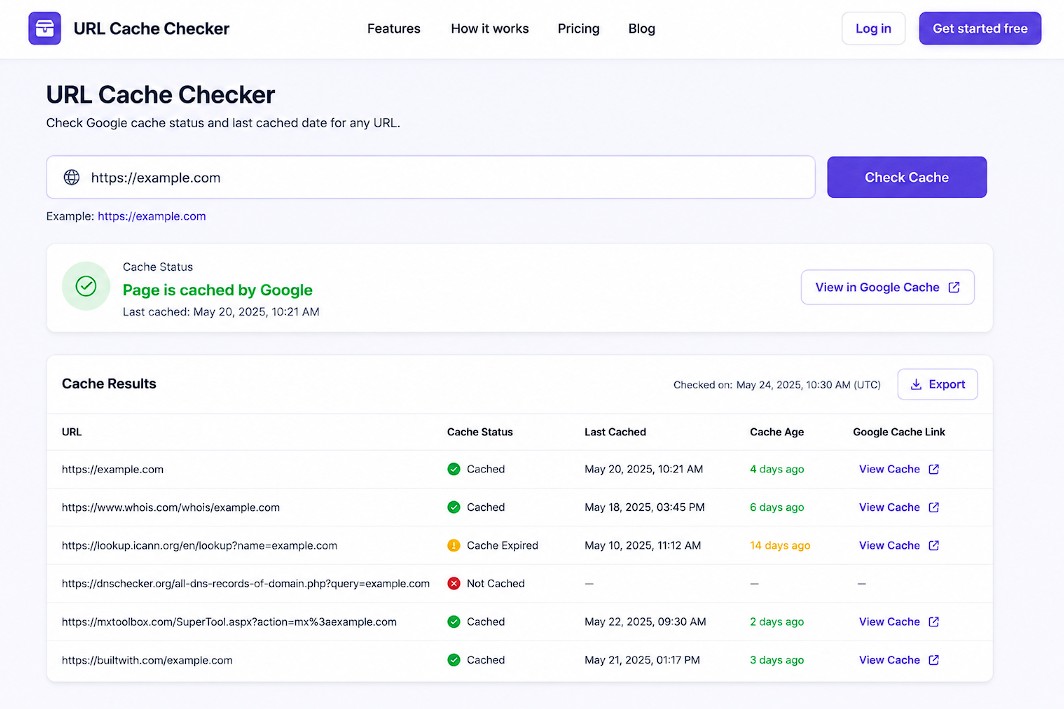
The tool queries Google’s cache for each submitted URL and returns one of three statuses:
- Cached: Google has a stored snapshot of the page. The date shown tells you when Googlebot last visited.
- Not cached: Google has no stored version. This can mean the page was never indexed, was de-indexed, has a
noindextag, or the cache simply expired. - Unavailable: The check could not be completed, usually due to a temporary Google-side issue.
Alaikas also makes this a standalone tool you can use without logging into a platform or exporting data to another service. That matters when you’re doing a quick spot-check mid-audit rather than a full crawl.
How to Use the Google Cache Checker by Alaikas Step by Step
Using the tool takes under a minute per batch, but getting value from it requires knowing what to look for in the output.
Step 1: Collect the URLs you want to check. Pull these from your site’s XML sitemap, a Screaming Frog crawl export, Google Search Console’s Coverage report, or a list of your highest-priority pages. Prioritize pages you recently published, recently updated, or are actively targeting for rankings.
Step 2: Paste the URLs into the Google Cache Checker by Alaikas input field. Depending on the current interface, you can enter one URL per line or upload a CSV.
Step 3: Run the check. The tool queries Google’s cache for each URL and returns the status and (where available) the cached date.
Step 4: Sort by status. Pull out every URL showing “not cached” or “unavailable.” These are your immediate follow-ups.
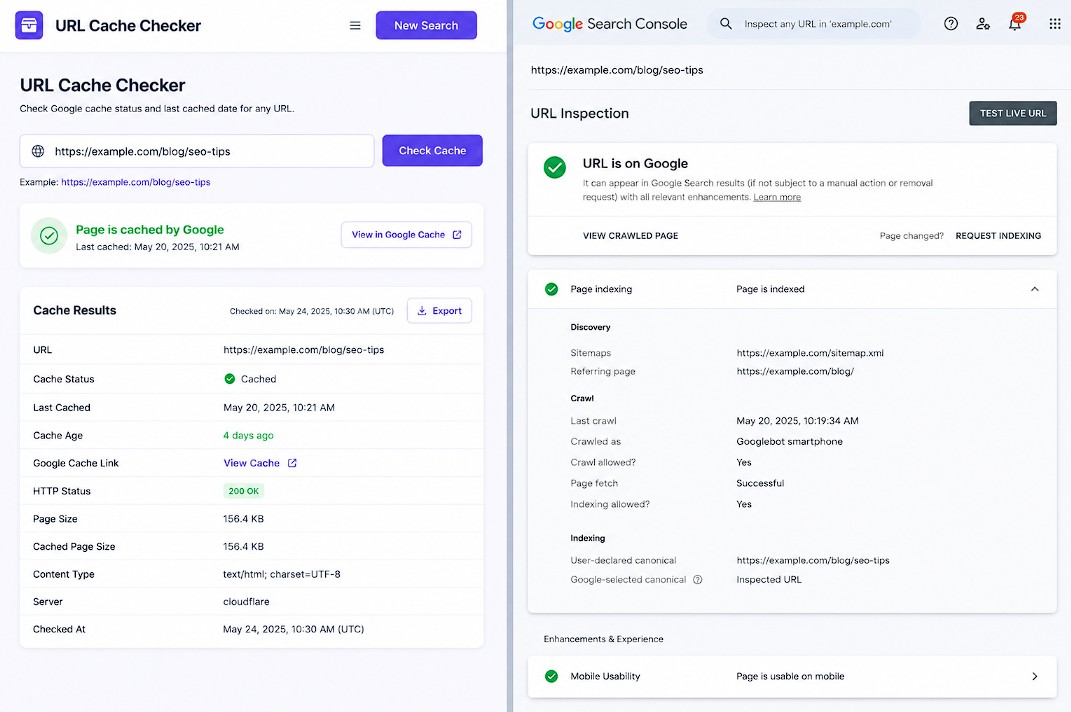
Step 5: Cross-reference with Google Search Console. For any page showing “not cached,” check its status in GSC’s URL Inspection tool. Look for crawl errors, noindex tags, canonical conflicts, or low coverage status like “Discovered but not indexed” or “Crawled but not indexed.”
A few things to keep in mind:
- Cache status does not directly equal ranking. A page can rank without being recently cached, and a cached page is not guaranteed to rank.
- A very old cache date (weeks or months ago) on a page you recently updated means Googlebot hasn’t returned. This is relevant if you made SEO changes and are wondering why they haven’t had any effect.
- If a large percentage of your site shows “not cached,” look at your crawl budget, internal linking structure, and whether you have a crawl-blocking issue in your robots.txt.
When you have a long list of URLs to work through, running them through a bulk URL opener alongside this tool makes it faster to spot-check the actual cached versions directly in Google rather than relying entirely on the tool’s output.
What the Google Cache Checker by Alaikas Tells You About Indexing
Cache status is not the same as index status, but the two are closely related. Understanding the difference makes the data from this tool a lot more useful.
Cached vs. indexed: A page can appear in Google’s index without showing a cached version (Google deprecated the cache: operator for many users in 2024, though the underlying cache mechanism still exists for crawling purposes). A page that shows as “not cached” in the Alaikas tool may still be indexed and ranking. What the tool specifically checks is whether Google has stored a retrievable snapshot.
What a missing cache most often signals:
- The page has a
noindexdirective. Google respects this and won’t cache the page. - The page is new and hasn’t been crawled yet. Googlebot doesn’t visit every page at the same frequency. New pages on low-authority sites can wait days or weeks.
- The page was recently taken down or returned a 4xx/5xx error during Googlebot’s last visit.
- The page exists in Google’s index but the snapshot has expired or was never stored.
What a stale cache date signals:
If Google last cached a page two months ago and you’ve made significant content updates since then, those updates aren’t yet reflected in what Google has stored. For SEO changes (title tags, meta descriptions, structured data, content additions), this means the impact won’t show up until the next crawl.
For high-priority pages, a stale cache date is a reason to request reindexing via GSC’s URL Inspection tool rather than waiting for Googlebot to revisit on its own schedule.
The Google Cache Checker by Alaikas is most useful as a quick triage tool. It surfaces the pages most likely to have indexing problems so you can investigate with the right tools (GSC, Screaming Frog, log file analysis) rather than auditing your entire site hoping to find the issue.
Using the Google Cache Checker by Alaikas in a Real SEO Audit
The tool fits cleanly into a few specific audit scenarios. Here’s how it works in practice.
After a site migration: Post-migration is one of the highest-risk periods for indexing issues. Redirect chains, incorrect canonical tags, and robots.txt errors can all quietly prevent Google from caching pages on the new domain or URL structure. Running a cache check on your most important 50 to 100 URLs within the first week after migration gives you early warning before ranking drops show up in your data.
After publishing new content: You published 20 new blog posts last month. Running them through the Google Cache Checker by Alaikas tells you within seconds which ones Google has visited and cached vs. which ones it hasn’t touched. If 15 out of 20 are cached and 5 aren’t, those 5 warrant a closer look at their internal linking and whether they’re included in your sitemap.
After making on-page SEO changes: You updated title tags, heading structure, or body content on a batch of pages to improve rankings. A cache check tells you whether Googlebot has seen the updated versions. If it hasn’t, the changes have had zero SEO effect so far, and you may want to manually request reindexing for the most important ones.
During a crawl budget audit: If you’re running a site with tens of thousands of pages and suspect Googlebot is spending crawl budget on low-value pages, a cache check on your deep-linked content tells you how far down the site structure Googlebot is consistently reaching. Pages that are consistently not cached despite being in your sitemap usually mean Googlebot is prioritizing other parts of your site.
For workflows where you’re checking large batches of URLs and also want to open cached versions directly in Google to review them, a tool like URL Opener Pro lets you open 50 or more URLs simultaneously rather than working through them one by one.
Common Issues Found with the Google Cache Checker by Alaikas
A few patterns come up repeatedly when SEOs use this tool on real sites.
Large sections of the site not cached after a relaunch. Usually traced back to a robots.txt file that’s still blocking Googlebot from crawling the new URL structure, or a sitemap that wasn’t updated to reflect the new URLs.
Pages cached with the old content after an update. This is normal but frustrating. The fix is to submit updated URLs for reindexing in GSC rather than waiting for Googlebot’s next pass. For a batch of pages, GSC’s bulk sitemap submission is more efficient than individual URL inspection requests.
Key landing pages cached less frequently than blog posts. Googlebot typically crawls pages with more frequent content updates (blogs, news sections) more often. If your core service pages are being cached monthly and your blog is cached weekly, you have a crawl frequency imbalance. Improving internal links to your landing pages from frequently updated content tends to help.
“Not cached” on pages that rank well. This is less intuitive but it happens. Google doesn’t need a fresh cached snapshot to keep a page ranking. If rankings are stable and the page is visible in GSC’s index coverage as “indexed,” the lack of a cached version in the Alaikas tool may be a display issue rather than an indexing problem.
Conclusion
The Google Cache Checker by Alaikas removes one repetitive step from the SEO audit process: manually checking whether Google has a stored snapshot of your pages. That’s a small thing in isolation, but across a 500-page audit, it saves a meaningful amount of time and surfaces problems that slower diagnostic methods might miss for days.
Cache status alone won’t tell you why a page isn’t ranking. It tells you whether Googlebot has visited and stored a version of the page, which is the minimum requirement for any of your other SEO work to have an effect. Run it on your most important pages after any significant site change, cross-reference the output against GSC, and you’ll catch indexing gaps before they become ranking gaps.
Frequently Asked Questions
What is the Google Cache Checker by Alaikas?
The Google Cache Checker by Alaikas is a free tool that checks whether Google has stored a cached (snapshot) version of a given URL. You enter one or more URLs, and the tool returns whether each page is cached, not cached, or unavailable. It’s designed to speed up the manual process of running cache: lookups in Google Search.
How does Google cache work?
When Googlebot crawls a page, it stores a snapshot of that page on Google’s servers. This snapshot, called the cached version, reflects how the page looked at the time of the last crawl. Google uses this for its own processing but also made it accessible to users through the cache: search operator (though Google officially deprecated the public cache viewing feature in 2024, the underlying crawl-based caching mechanism still exists).
Is a cached page the same as an indexed page?
Not exactly. An indexed page appears in Google’s search results. A cached page has a stored snapshot on Google’s servers from a recent crawl. Most indexed pages will have a cache entry, but it’s possible for a page to be indexed without a fresh cache (if the cache expired) or to show as “not cached” in some tools while still appearing in search results.
Why would a page show as “not cached” in the Google Cache Checker by Alaikas?
Several reasons: the page has a noindex tag, the page was never crawled by Googlebot, Googlebot encountered an error (4xx or 5xx) during its last visit, the cache expired without a new crawl, or the page is blocked in the site’s robots.txt file. Each of these requires a different fix.
Does cache status affect rankings?
Not directly. Google doesn’t use cache freshness as a ranking signal. However, a page that hasn’t been cached recently usually means Googlebot hasn’t visited recently, which means any SEO changes you made since the last crawl haven’t been processed yet. In that sense, a stale or missing cache indirectly delays the impact of your optimization work.
How often does Google update its cache?
It varies by page. Google crawls high-authority, frequently updated pages (major news sites, popular blogs) as often as several times per day. Low-authority or rarely updated pages may only be crawled every few weeks or months. If you need Googlebot to revisit a specific page sooner, submit it for reindexing via the URL Inspection tool in Google Search Console.
Can I check multiple URLs at once with the Google Cache Checker by Alaikas?
Yes. The tool supports bulk URL input, which is one of its main advantages over manual cache: searches in Google. You paste a list of URLs and receive results for all of them at once, making it practical to use during site audits rather than just for individual page checks.
What should I do if an important page is not cached?
First, check the page in Google Search Console’s URL Inspection tool to see whether it’s indexed. If it is indexed, submit it for reindexing so Googlebot revisits it soon. If it’s not indexed, look for a noindex tag, a robots.txt block, a canonical tag pointing to a different URL, or a crawl error. Fix the underlying issue before requesting reindexing.
Is the Google Cache Checker by Alaikas free to use?
Yes. The tool is available for free. You don’t need to create an account or install software to run basic cache checks.
How is this different from checking the cache manually in Google?
The manual method requires you to type cache:yoururl.com into Google Search for each URL individually. Google also removed the clickable cache link from search results in 2024, making manual checks less convenient. The Alaikas tool automates this process and supports bulk lookups, which saves time when you’re auditing multiple pages or running post-publish checks on a batch of new content.
Can cache checker results be wrong?
Occasionally. The tool depends on Google’s responses, and temporary server-side issues can produce “unavailable” results for pages that are actually cached. If you see unexpected results, wait a few minutes and recheck those specific URLs, or verify them manually by inspecting the page in Google Search Console.
Should I use a cache checker after every content update?
Not necessarily for every update. For minor copy edits, a cache check adds little value. Where it earns its place is after major changes: site migrations, large-scale URL restructuring, bulk content updates targeting specific keywords, or any update where you need to confirm Google has processed the new version before drawing conclusions about ranking performance.