Most meta tags are written wrong. Not because people don’t understand SEO — because they’re guessing character counts, second-guessing keyword placement, and burning time on a task that should take seconds. The Meta Tag Generator by alaikas fixes all of that. It’s a free, browser-based tool that generates optimized title tags and meta descriptions instantly, so you stop guessing and start publishing pages that rank.
This guide covers how the tool works, what makes it worth using over alternatives, how to apply its output inside real SEO workflows, and the mistakes most people make when writing meta tags even with a generator in hand.
Contents
- 1. What the Meta Tag Generator by Alaikas Actually Does
- 2. How to Use the Meta Tag Generator by Alaikas in an SEO Workflow
- 3. Why the Meta Tag Generator by Alaikas Outperforms Generic Alternatives
- 4. Common Meta Tag Mistakes the Meta Tag Generator by Alaikas Helps You Avoid
- 5. How the Meta Tag Generator by Alaikas Fits Into a Technical SEO Audit
- 6. Conclusion
- 7. Frequently Asked Questions
- 7.1. What is the Meta Tag Generator by alaikas?
- 7.2. Is the Meta Tag Generator by alaikas free to use?
- 7.3. How many characters should a title tag be?
- 7.4. Does the meta description affect Google rankings?
- 7.5. Can I use the alaikas meta tag generator for every page on my site?
- 7.6. What HTML tags does the Meta Tag Generator by alaikas produce?
- 7.7. How is the alaikas meta tag generator different from Yoast SEO?
- 7.8. Should my target keyword appear in the meta description?
- 7.9. Can I use the same meta description on multiple pages?
- 7.10. What happens if I leave the meta description blank?
- 7.11. Does the alaikas meta tag generator work on mobile?
- 7.12. When should I update my meta tags?
- 7.13. Can the alaikas meta tag generator help with Open Graph tags?
What the Meta Tag Generator by Alaikas Actually Does
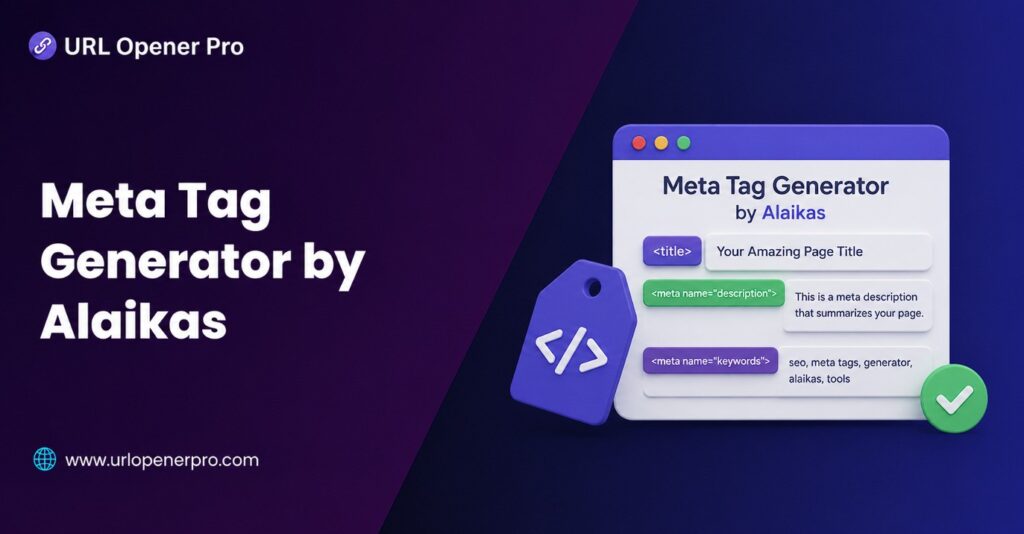
The Meta Tag Generator by alaikas is a free on-page SEO tool that generates HTML-ready title tags and meta descriptions based on your input. You enter your page title, target keyword, and a short description of the page. The tool formats the output to meet Google’s recommended character limits: 50 to 60 characters for title tags, 150 to 160 characters for meta descriptions.
That last part matters more than people give it credit for. Google truncates title tags that exceed 60 characters in desktop search results and around 78 characters in mobile. A truncated title tag loses click context and can hurt CTR. The alaikas generator shows you character count in real time, so you know exactly when you’ve crossed the line.
The core output you get
The tool produces two things you can copy and paste directly into your CMS or HTML:
- A
<title>tag with your keyword placed naturally at or near the front - A
<meta name="description">tag with a clean, complete description under 160 characters
It also generates the standard <meta charset>, <meta name="viewport">, and <meta name="robots"> tags, giving you a complete head section snippet for any new page.
[Screenshot: The alaikas Meta Tag Generator interface showing input fields for title, keyword, and description, with real-time character counters and HTML output preview]
Why character limits actually affect rankings
Google rewrites title tags it considers too long, too short, or keyword-stuffed. A 2021 analysis by Portent found that Google rewrites title tags about 61% of the time when the original title doesn’t match the page content well. The alaikas generator keeps your title in the sweet spot where Google is least likely to override it.
How to Use the Meta Tag Generator by Alaikas in an SEO Workflow
The tool is fast, but using it carelessly produces generic meta tags that technically fit the character limits and do nothing for CTR. Here’s how to use it properly inside a real workflow.
Step 1: Start with your keyword research, not the tool
Before you open the meta tag generator, know the primary keyword for the page. Pull it from Ahrefs, SEMrush, or Google Search Console. Paste the exact search phrase you’re targeting. Do not paraphrase it inside the title tag — Google matches queries to title tag text literally, and a close variant is not the same as the exact phrase.
Step 2: Write your title tag formula first
Strong title tags follow a consistent formula: Primary Keyword | Brand Name or Primary Keyword: Benefit or Context. The alaikas generator lets you enter your title as free text, so write the formula first on paper or in a text editor, then paste it in. The generator confirms you’re under 60 characters. That’s all you need from this step.
Step 3: Write the meta description as a standalone sell
The meta description does not directly affect keyword rankings, but it determines whether someone clicks your result or the one below it. Write it as if you’re writing a two-sentence ad: describe what the page delivers, name the outcome the reader gets, and give them a reason to click now rather than later. The alaikas generator’s character counter shows you when you’ve hit 155 to 160 characters, which is the optimal range for desktop and mobile SERP display.
Step 4: Copy the HTML output and paste into your CMS
Alaikas generates the complete HTML tags. In WordPress, you paste the meta description into the Yoast SEO or Rank Math field — not the raw HTML. In a custom CMS or static site, paste the entire tag block into the <head> section. In Shopify, the title tag goes into the SEO title field under each product or page editor.
Step 5: Validate with Google’s Rich Results Test
After publishing, run the URL through Google’s Rich Results Test (search.google.com/test/rich-results). It shows you exactly how Google reads your <head> section, including whether your title and meta description tags are being picked up correctly.
Why the Meta Tag Generator by Alaikas Outperforms Generic Alternatives
There are dozens of free meta tag generators. Most produce the same output: a pre-filled template you edit manually with no real guidance on what good looks like. The alaikas version is tighter because it keeps the interface focused on the two tags that move the needle — title and meta description — without cluttering the output with tags you don’t need.
Comparing against other free tools
Metatags.io is a popular alternative with a live SERP preview, which is useful for visualizing desktop results. SEOptimer’s meta tag tool is more of an audit tool than a generator. The Yoast SEO plugin inside WordPress provides character counters in-app but requires the plugin itself. The alaikas tool runs in the browser with no login, no plugin install, and no account. For one-off pages, new site builds, or any situation where you need meta tags without a full CMS setup, it’s faster than every alternative listed here.
What the tool does not do
It does not suggest keywords, pull search volume data, or audit your existing meta tags. For keyword research, you still need Ahrefs or SEMrush. For bulk meta tag audits, Screaming Frog’s SEO Spider is the standard: crawl the site, export the meta tag report, identify missing or duplicate tags, then use the alaikas generator to draft replacements. Once you have a list of corrected URLs to check live, a bulk URL opener like URL Opener Pro lets you open all of them in parallel tabs at once, cutting audit review time significantly.
Common Meta Tag Mistakes the Meta Tag Generator by Alaikas Helps You Avoid
Even with a generator, most meta tag errors are habitual. The tool enforces the right constraints — but only if you know what to put into it.
Mistake 1: Keyword stuffing the title tag
“Best Meta Tag Generator | Free Meta Tag Generator Tool | Meta Tag Creator” reads as spam to Google and to users. Google’s quality guidelines explicitly flag keyword repetition in title tags. One primary keyword, placed near the front, is sufficient. The alaikas generator does not prevent keyword stuffing, but the character limit does — you simply run out of space before you can repeat the keyword twice in a meaningful way.
Mistake 2: Writing the meta description as a keyword dump
“Meta tag generator, free meta tag tool, SEO meta tags, meta description generator, title tag generator.” That is a list of keywords, not a description. Google ignores meta description content for ranking purposes, but it reads the text directly to users in the SERP. If it reads like spam, users skip it. Write for the human who is deciding whether to click.
Mistake 3: Using the same meta description across multiple pages
Duplicate meta descriptions are flagged in Google Search Console under the “HTML improvements” section. Each page needs a unique description that matches its specific content. If you’re generating meta tags for a 50-page site, create a simple spreadsheet with one row per URL, draft the meta descriptions in bulk, then use the alaikas generator to check character counts for each one before publishing.
Mistake 4: Ignoring mobile truncation
Mobile SERPs display shorter titles than desktop. Google shows roughly 78 characters on mobile for title tags, but the visible portion in most themes and results is closer to 60. Writing to 60 characters keeps your title intact on both. The alaikas generator uses 60 as the target, which is the right call.
Mistake 5: Not updating meta tags after content changes
A page about “best Chrome extensions for SEO in 2023” that still has that year in the title tag and meta description signals to users that the content is stale. Update the meta tags every time you do a significant content refresh. The alaikas generator takes 30 seconds per page, so there’s no reason to let outdated meta tags sit.
How the Meta Tag Generator by Alaikas Fits Into a Technical SEO Audit
Technical SEO audits almost always surface meta tag issues: pages with missing title tags, pages with duplicate descriptions, title tags that exceed 60 characters, meta descriptions that are blank. The alaikas tool is the fix-side of that equation.
Running a Screaming Frog export with alaikas
In Screaming Frog’s SEO Spider, crawl your site and navigate to the “Meta Description” tab under “Internal.” Sort by length to find descriptions that are too short (under 120 characters) or too long (over 160). Export the URL list. For each URL, open the page, pull the target keyword from its H1, paste both into the alaikas meta tag generator, and produce a replacement description.
For sites with more than 20 pages to fix, that URL export from Screaming Frog is a long list. Paste all the URLs into URL Opener Pro to open every page at once, audit the current meta tags visually, and work through the rewrites in one sitting instead of clicking back and forth one page at a time.
Using it during a content audit
Content audits involve reviewing every page for traffic, relevance, and accuracy. When a page gets updated, the meta tags should be updated too. Build the alaikas generator into your content audit checklist as a mandatory last step for every page that gets a significant rewrite. It takes less than a minute and prevents the situation where updated content is paired with a 2022-era meta description.
Conclusion
The Meta Tag Generator by alaikas does one thing well: it removes the guesswork from title tag and meta description writing. It enforces the right character limits, outputs clean HTML, and runs in the browser without requiring an account or a plugin. That’s the entire value proposition, and it’s enough.
What the tool cannot do is make your meta tags compelling. That part is still on you. Write title tags that place the keyword near the front and give users a reason to click. Write meta descriptions that describe a specific outcome, not a keyword list. Use the generator to confirm the format, but bring your own judgment to the content. Start with the alaikas generator on your next page build and see how much time you get back.
Frequently Asked Questions
What is the Meta Tag Generator by alaikas?
The Meta Tag Generator by alaikas is a free, browser-based SEO tool that generates optimized HTML title tags and meta descriptions. You enter your page title, target keyword, and a short description, and the tool produces formatted HTML output with real-time character count tracking to keep your tags within Google’s recommended limits.
Is the Meta Tag Generator by alaikas free to use?
Yes, the tool is completely free. There is no account creation, no subscription, and no paywall. You access it directly in your browser and generate as many meta tags as you need without limitations.
How many characters should a title tag be?
Google recommends keeping title tags between 50 and 60 characters. Tags longer than 60 characters are often truncated in desktop search results, and Google sometimes rewrites title tags that are too long, too short, or don’t match the page content. The alaikas generator uses 60 characters as its target length.
Does the meta description affect Google rankings?
Meta descriptions are not a direct ranking factor. Google has confirmed this. However, a well-written meta description improves click-through rate in search results, which sends behavioral signals that can indirectly influence how Google evaluates a page’s relevance over time.
Can I use the alaikas meta tag generator for every page on my site?
Yes. The tool is designed for single-page use, so for large sites with many pages, you’ll generate tags one at a time. For bulk meta tag audits, use Screaming Frog to identify pages with issues, then use the alaikas generator to write corrections for each flagged page.
What HTML tags does the Meta Tag Generator by alaikas produce?
The tool generates the <title> tag, <meta name="description">, <meta charset="UTF-8">, <meta name="viewport">, and <meta name="robots"> tags. This gives you a complete starter block for the <head> section of any page.
How is the alaikas meta tag generator different from Yoast SEO?
Yoast SEO is a WordPress plugin that provides meta tag fields inside the post editor with built-in character counters. The alaikas generator is a standalone browser tool that works outside of any CMS. It’s faster for one-off use, works without a WordPress installation, and doesn’t require a plugin at all.
Should my target keyword appear in the meta description?
Including the primary keyword in the meta description is a best practice for user relevance, even though it doesn’t affect rankings. When a user’s search query matches text in the meta description, Google bolds that text in the SERP, making your result more visually prominent and improving click-through rate.
Can I use the same meta description on multiple pages?
No. Duplicate meta descriptions across multiple pages are flagged by Google Search Console as an HTML improvement issue. Each page should have a unique description that accurately reflects that specific page’s content. Using the same description across pages can confuse users and may signal thin or duplicate content to Google.
What happens if I leave the meta description blank?
If no meta description tag is present, Google generates one automatically from the page content. Google’s auto-generated descriptions are often pulled from random body text and rarely describe the page well enough to drive clicks. Writing your own gives you control over how your page appears in search results.
Does the alaikas meta tag generator work on mobile?
Yes. The tool is browser-based and responsive, so it works on mobile devices. However, for workflows involving multiple pages or copy-pasting HTML into a CMS, a desktop browser is more practical.
When should I update my meta tags?
Update your title tag and meta description any time you significantly revise the page content, change the primary keyword target, update a year reference in the content, or when you notice a CTR drop in Google Search Console for that URL. Meta tags are not set-and-forget — they should evolve with your content.
Can the alaikas meta tag generator help with Open Graph tags?
The core tool focuses on the HTML title tag and meta description. Open Graph tags (used for Facebook and LinkedIn link previews) are a separate set and may require additional tools or manual entry depending on your CMS. Yoast SEO and Rank Math both handle Open Graph tags within WordPress if you need full social tag coverage.