Key Takeaways
- Custom website design from Garage2Global is built around conversion and SEO architecture, not just aesthetics.
- Every page is structured with user intent, load speed, and search crawlability in mind from the start.
- Garage2Global’s design process integrates technical SEO, CRO principles, and scalable code architecture together rather than treating them as separate projects.
- A custom site consistently outperforms template builds in rankings and conversion because it is optimized for how real users and search engines actually behave.
- The long-term cost of a cheap website (lost traffic, redesigns, and missed conversions) is almost always higher than the upfront investment in a properly built one.
Most business websites look fine on the surface and completely fail in practice. They load slowly, rank nowhere, confuse visitors, and convert at under 1%. That is not a design problem. That is a strategy problem disguised as a design problem.
Custom Website Design by Garage2Global approaches this differently. Instead of building a site that looks good in a portfolio screenshot, they build for what actually matters: organic search visibility, user behavior signals, conversion pathways, and long-term scalability. If you have been burned by a freelancer who delivered a beautiful site that drove no traffic, or a template build that broke every time you touched it, this article will show you what a properly engineered custom website actually looks like and why the difference shows up directly in revenue.
I have worked with dozens of businesses on SEO and website performance. The pattern is consistent: sites that were built around conversion and search architecture from day one significantly outperform retrofitted ones. The structure you start with determines the ceiling you are working against for years. Getting this right at the build stage is one of the highest-leverage decisions a business owner can make.
What Custom Website Design by Garage2Global Actually Delivers
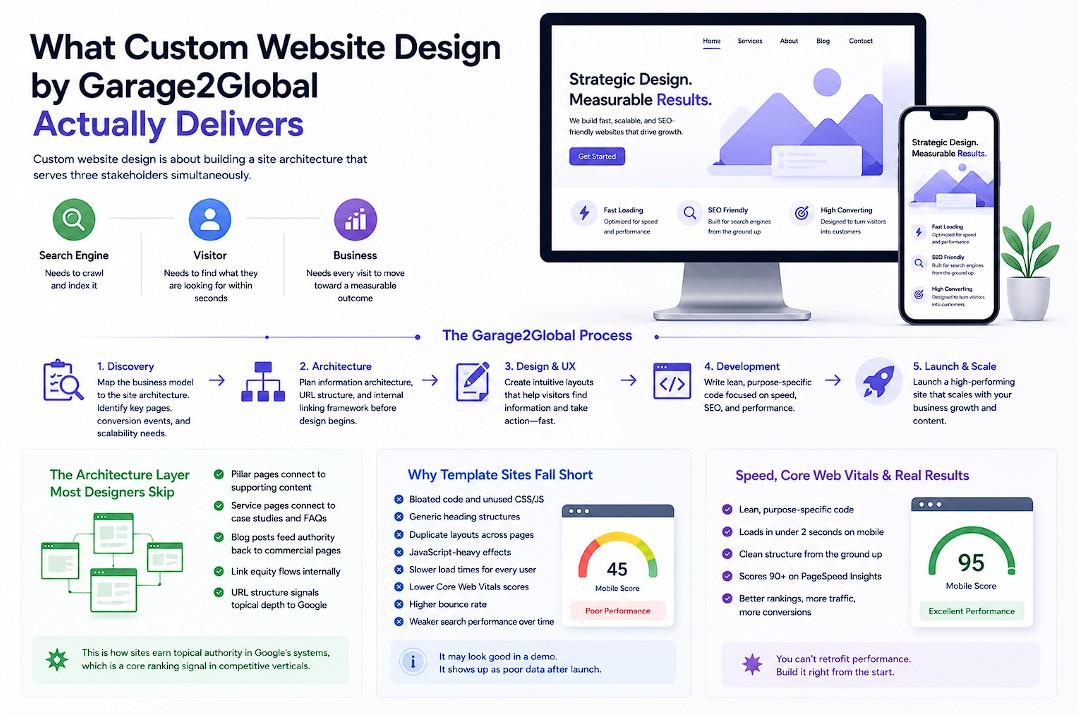
Custom website design by Garage2Global is not about hand-coding every pixel from scratch for novelty. It is about building a site architecture that serves three stakeholders simultaneously: the search engine that needs to crawl and index it, the visitor who needs to find what they are looking for within seconds, and the business that needs every visit to move toward a measurable outcome.
The distinction between a custom build and a premium template matters more than most business owners realize. Templates are designed for the average use case. They carry bloated code, generic heading structures, duplicate layout patterns across pages, and JavaScript-heavy visual effects that slow load times for every user on every page. None of that is visible in a demo environment. It shows up in your Core Web Vitals report, your bounce rate, and your Google Search Console data six months after launch.
Garage2Global’s process starts with a discovery phase that maps the business model to the site architecture. Which pages need to rank? What conversion events matter: calls, form fills, product purchases, demo requests? How does the site scale when you add 50 new service pages or a blog with 300 posts? These are not afterthoughts. They are the blueprint.
The Architecture Layer Most Designers Skip
The part that separates a high-performing custom site from a visually identical one is information architecture. That means: how pages relate to each other, how link equity flows internally, how the URL structure signals topical depth to Google, and how navigation is structured to reduce friction for real users.
Garage2Global builds internal linking frameworks before the first page is designed. Pillar pages connect to supporting content. Service pages connect to case studies and FAQs. Blog posts feed authority back to commercial pages. This is not decorative structure. It is how sites earn topical authority in Google’s systems, which is a core ranking signal in competitive verticals.
If you are not familiar with how topical authority works and why it affects rankings, this is something I cover in depth in my SEO consulting work with service businesses. The short version: Google rewards sites that demonstrate comprehensive, organized expertise in a subject area. Structure is how you demonstrate that.
Speed, Core Web Vitals, and Why Template Sites Fail Here
Google’s Core Web Vitals (Largest Contentful Paint, Cumulative Layout Shift, and Interaction to Next Paint) are direct ranking signals. A site that scores below 75 on PageSpeed Insights for mobile is losing rankings to competitors who score above 90. That gap translates directly to less organic traffic.
Template builds on platforms like Elementor or Divi routinely score in the 30 to 55 range on mobile without significant optimization. The reason is structural: these builders output CSS and JavaScript that covers every possible layout variation, most of which your site will never use. The browser loads all of it anyway.
Garage2Global writes lean, purpose-specific code. The output is a site that loads in under 2 seconds on mobile on a standard connection, not because of compression tricks layered on top of a bloated base, but because the base is clean to begin with. That is a technical outcome you cannot retrofit cheaply after the fact.
How Custom Website Design by Garage2Global Integrates SEO from Day One
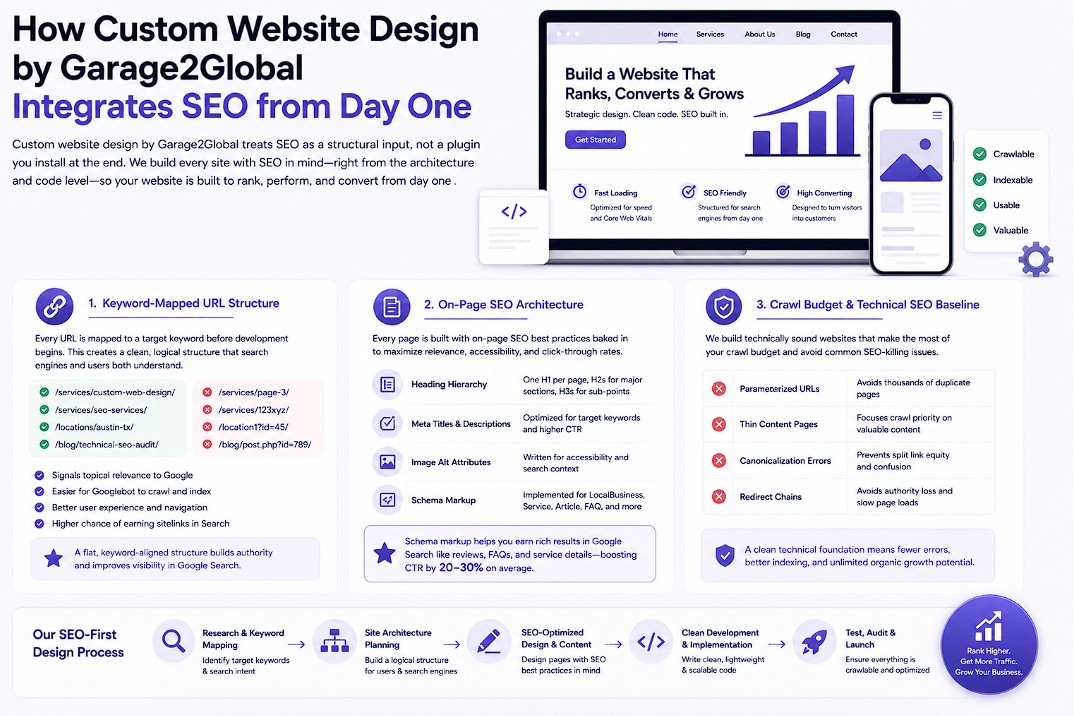
Custom website design by Garage2Global treats SEO as a structural input, not a plugin you install at the end. This is the most important thing I can tell you about what separates high-ranking sites from average ones: SEO cannot be bolted on after a site is built. The decisions made at the architecture and code level either support or sabotage your ability to rank, and most of those decisions are made before the first page is designed.
Here is what that looks like in practice.
Keyword-Mapped URL Structure
Every URL on a Garage2Global site is mapped to a target keyword before development begins. That means /services/custom-web-design/ rather than /services/page-3/. It means location pages follow a consistent pattern that signals geographic relevance without creating duplicate content. It means blog categories reflect actual search clusters, not arbitrary editorial labels.
This matters because Google reads your URL structure as a signal of site organization and topical relevance. A flat, keyword-aligned structure is easier for Googlebot to crawl, easier for users to navigate, and more likely to earn the sitelinks display in Google Search that signals authority to searchers.
On-Page SEO Architecture
Every page that Garage2Global builds ships with a correctly structured heading hierarchy (one H1 per page, H2s for major sections, H3s for sub-points), meta titles and descriptions optimized for click-through rate, image alt attributes written for accessibility and search context, and schema markup for the content type (LocalBusiness, Service, Article, FAQ, etc.).
Schema markup alone is something 70% of small business websites get wrong or skip entirely. It is how you get rich results in Google Search: star ratings, FAQ dropdowns, service details, and review counts displayed directly in the SERP. These lift click-through rates by 20 to 30% on average without requiring any improvement in ranking position.
Crawl Budget and Technical SEO Baseline
For larger sites, crawl budget becomes a real factor. Garage2Global avoids the common mistakes that waste it: parameterized URLs that generate thousands of duplicate pages, thin content stubs that dilute crawl priority, canonicalization errors that split link equity, and redirect chains that bleed authority across page loads.
If you have ever run a technical SEO audit on a template-built site, you know what this looks like in practice. Hundreds of crawl errors, multiple pages competing for the same keyword, canonical tags pointing in circles. These are not minor issues. They cap your organic growth until someone goes in and fixes them page by page. (I do exactly this kind of cleanup in my SEO audit work, and it is consistently one of the highest-ROI engagements I run for clients.)
The Conversion Framework Behind Custom Website Design by Garage2Global
Custom website design by Garage2Global is built around one core question per page: what is the one thing this visitor needs to do next? Not two things. Not five. One. That question determines layout, copy hierarchy, CTA placement, and the visual weight of every element on the page.
This is conversion rate optimization (CRO) applied at the design stage, not as a separate audit you buy six months after launch. Getting traffic to a page means nothing if the page does not convert that traffic into a lead, a sale, or the next click in a purchase journey.
CTA Architecture and Visual Hierarchy
Garage2Global designs CTA placement based on scroll behavior data, not aesthetic preference. Primary CTAs appear above the fold and in the natural resting point of the scroll (typically 60 to 70% down the page). Secondary CTAs appear in the footer and in contextual breakpoints throughout long-form pages.
The visual hierarchy is built to direct attention without competing elements. The most important thing on a landing page gets the most visual weight. Everything else supports it. This sounds obvious. Very few sites actually execute it. Most business pages have three competing CTAs, a navigation bar full of escape routes, and a hero section that says something like “Welcome to our website” in 60-point font.
Trust Signal Placement
Conversion drops sharply when visitors cannot quickly establish that you are a legitimate, credible business. Garage2Global structures trust signals (client logos, review counts, case study links, certifications, team photos) into specific layout positions informed by how users scan web pages (F-pattern and Z-pattern reading behavior, depending on the page type).
The difference between a trust signal placed as an afterthought at the bottom of a page and one placed in the visual hierarchy where the user’s eye naturally rests during their decision moment is measurable in conversion rate. It is typically a 15 to 40% difference in lead form completion rates across A/B tests I have seen run on service business sites.
Landing Page vs. Website Architecture
Garage2Global also distinguishes between pages that should function as closed landing pages (no navigation, single conversion path, used for paid traffic or specific campaigns) and pages that should function as organic content hubs (full navigation, internal links, supporting content). Mixing these up is one of the most expensive mistakes in web design.
A service page with a navigation bar full of escape routes will consistently underperform against a stripped landing page for paid campaigns. A stripped landing page with no internal links will underperform in organic search because it cannot build topical authority. Garage2Global designs both, correctly, for their respective purposes.
Why Businesses Choose Custom Website Design by Garage2Global Over Template Builds
Custom website design by Garage2Global consistently wins on three metrics that actually determine whether a website produces revenue: long-term SEO performance, conversion rate, and the cost of ownership over a 3 to 5 year horizon.
The upfront cost of a custom build is higher than a Squarespace site or a Fiverr WordPress setup. That is true. What is also true is that most businesses redesign their website every 18 to 24 months when the cheap build stops performing, which means they pay the low price multiple times plus they absorb months of lost traffic and leads with each transition.
The Real Cost of a Cheap Website
Here is what a typical low-cost website actually costs over 36 months: the initial build, one or two emergency developer calls when something breaks, a plugin or theme renewal that causes a compatibility issue, a redesign when the performance problems become undeniable, and all the organic traffic and conversions that did not happen because the site was not built to rank or convert.
I have audited enough sites to recognize the pattern. A business that spent $1,500 on a website three years ago has often spent $4,000 to $6,000 total when you add the ongoing costs and the redesign. And they still do not have a site with a real SEO foundation.
A custom Garage2Global build, by contrast, ships with a scalable codebase, a documented content architecture, and a technical SEO baseline that does not require immediate remediation. The total cost of ownership over three years is typically lower, and the organic revenue generated is materially higher.
Scalability as a Design Requirement
Garage2Global builds with scale as a non-negotiable requirement. That means a CMS structure that lets you add 500 blog posts without creating crawl issues. It means page templates that maintain design consistency without requiring a developer every time you add content. It means a design system with documented components so that new pages match the existing site without starting from scratch.
This is what separates a site built by people who think in terms of business systems from one built by people who think in terms of deliverables. Deliverables end at launch. Systems continue to perform.
Common Mistakes to Avoid When Evaluating Website Design Services
Before you sign with any web design agency, including Garage2Global or anyone else, there are several mistakes I see businesses make repeatedly that lead to expensive outcomes.
Choosing based on portfolio aesthetics alone. A beautiful site that does not rank and does not convert is a cost center. Ask to see organic traffic data and conversion rates for portfolio sites, not just screenshots.
Skipping the technical SEO conversation. If your web designer does not bring up Core Web Vitals, crawl architecture, schema markup, and internal linking during the sales process, those things will not be in the build. Ask directly. The answer will tell you everything.
Underspecifying your conversion goals. A web designer cannot build for conversion if you have not told them what conversion means for your business. Is it a phone call? A form fill? A product purchase? A free trial signup? Get specific before the design brief is written.
Treating content as an afterthought. The structure of your site cannot be separated from the content strategy. Which pages need to exist, what they will say, how they connect to each other: these decisions have to happen before design begins, not after. Designing pages with placeholder text and filling in content later is one of the fastest ways to end up with a site that is built around the wrong architecture.
Not asking about post-launch support. A site needs ongoing technical attention: plugin updates, security patches, performance monitoring, and content additions that maintain the SEO architecture. Understand what is included and what is not before the contract is signed.
Conclusion
A website is not a digital brochure. It is the primary lead generation and conversion asset for most businesses, and it either works systematically or it does not. Custom Website Design by Garage2Global is built around that reality: structure first, search visibility baked in, conversion pathways engineered from the start.
If you are evaluating a website redesign or building from scratch, start with the architecture conversation before you talk about colors and fonts. The decisions made at the structural level will determine what your site is capable of for the next three to five years. Get those right, and the aesthetics follow naturally.
Frequently Asked Questions
What is custom website design and how is it different from a template build?
Custom website design is the process of building a website from the ground up based on a specific business’s goals, audience, and technical requirements rather than adapting a pre-built theme or template. The key differences are code quality, flexibility, and performance: custom builds carry no unnecessary code, can be structured exactly to support your SEO and conversion architecture, and scale cleanly as your business grows. Templates compromise on all three because they are designed for the average use case, not yours.
What makes Garage2Global’s website design process different from other agencies?
Garage2Global integrates SEO architecture, conversion rate optimization, and clean technical development into the same build process rather than treating them as separate services. Most agencies design first and optimize later. Garage2Global structures the site around how search engines crawl it and how users convert on it before a single page is designed. That sequence is the core difference.
How long does a custom website design project typically take with Garage2Global?
A typical custom website design project takes 8 to 16 weeks depending on the number of pages, content complexity, and how quickly the client can provide feedback and approvals. Larger sites with 50 or more pages, custom integrations, or eCommerce functionality take longer. The timeline is defined in the project scope before work begins.
Does a custom website from Garage2Global include SEO setup?
Yes. Garage2Global’s custom builds include on-page SEO foundations as a standard part of the build: keyword-mapped URLs, correctly structured heading hierarchies, meta titles and descriptions, image alt attributes, schema markup, and a technical configuration that meets Google’s crawlability standards. This is not an add-on. It is built into the process because a site that cannot rank is not a complete deliverable.
What CMS platform does Garage2Global build on?
Garage2Global builds primarily on WordPress (with a clean custom theme, not a page builder) and on modern headless or decoupled architectures for clients with more complex performance requirements. The platform recommendation comes from the discovery phase and is based on the client’s team’s ability to manage content post-launch, the scale of the site, and the performance requirements.
How does a custom website design improve conversion rates?
Conversion rate improvement comes from intentional layout design rather than aesthetic choices. This includes CTA placement based on scroll behavior data, visual hierarchy that directs attention to the most important action on the page, trust signal placement informed by user reading patterns, and page architecture that removes friction from the conversion path. These decisions are made at the design stage, not added after launch.
What is the typical investment for a custom website from Garage2Global?
Custom website projects vary significantly based on scope: number of pages, functionality requirements (eCommerce, booking systems, integrations), and content production. For a custom service business website in the 15 to 30 page range, expect investment in the range of $5,000 to $20,000 depending on complexity. Larger sites or those with custom functionality will be quoted separately. The relevant comparison is not against a $1,500 template build but against the total 3-year cost of ownership and the revenue generated.
Does Garage2Global handle website copywriting or just design and development?
Garage2Global’s primary scope is design and development, but they work with copywriting partners and can coordinate the content production process as part of the project. The content strategy (which pages need to exist, what keywords they target, what the conversion goal of each page is) is built into the discovery and architecture phase regardless of who writes the final copy.
How does custom website design affect organic search rankings?
A custom site affects organic rankings through several technical factors: faster load times and better Core Web Vitals scores that are direct ranking signals, cleaner crawl architecture that helps Googlebot index your pages correctly, a URL and internal linking structure that signals topical authority, and schema markup that enables rich results. These factors compound over time. A site built with clean technical foundations from day one will outrank a retrofitted template build on equivalent content within 6 to 12 months in most competitive verticals.
What happens after the website launches? Does Garage2Global provide ongoing support?
Garage2Global offers post-launch maintenance and support packages that cover security updates, performance monitoring, plugin management (on WordPress builds), and content additions that maintain the site’s technical architecture. The scope of post-launch support is defined in the contract. For clients who want ongoing SEO performance beyond the initial build, working with an SEO consultant in parallel ensures the content and authority-building strategy keeps pace with the technical foundation.
Is a custom website worth it for a small business or startup?
Yes, with one important caveat: if organic search is a meaningful acquisition channel for your business and your market is competitive, a custom site with proper SEO architecture will generate significantly more traffic and leads over a 3-year period than a template build. If you are a very early-stage startup that needs something live in two weeks to test a product concept, a template is fine to start. But as soon as search becomes part of your growth model, the architecture decisions matter and retrofitting them is more expensive than building them correctly the first time.