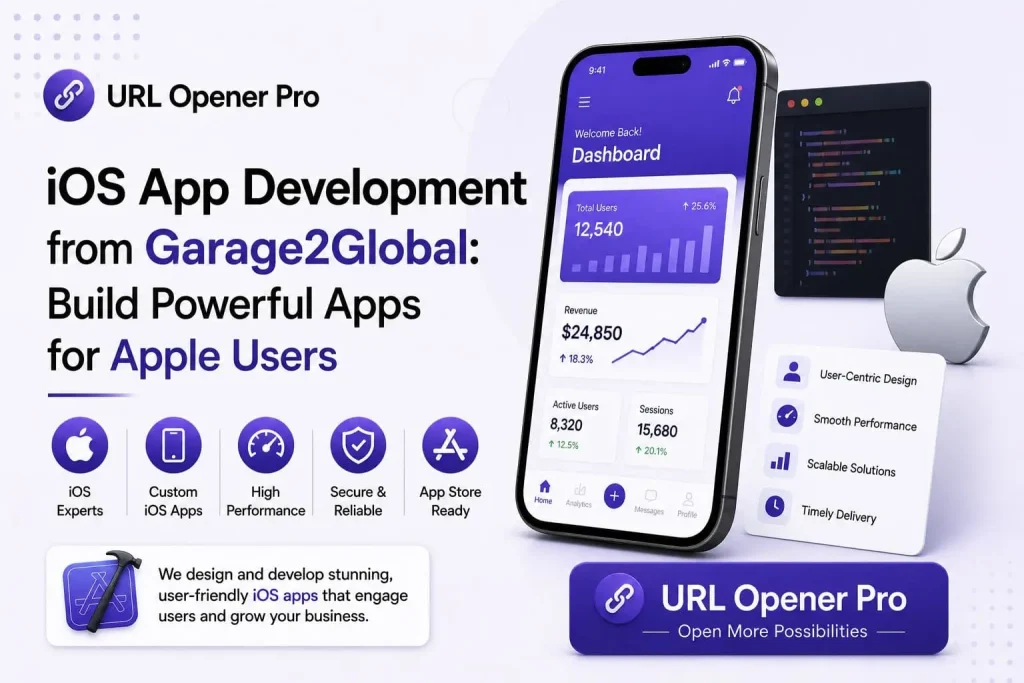
There are over 1.8 billion active Apple devices in the world. Every one of them runs apps built by developers who started exactly where you are right now: with an idea, a laptop, and zero users. The gap between that starting point and a live app on the App Store is not talent. It is a structured path that most people never follow correctly.
iOS App Development from Garage2Global is the framework that closes that gap. It is not about learning Swift in isolation or copying tutorials without understanding the decisions behind them. It is about building apps that Apple users actually want, that perform under real device conditions, and that have a fighting chance at generating revenue or traction in a marketplace with over 1.7 million competing apps.
This guide gives you that path. From your development environment through Swift fundamentals, UI architecture, backend integration, App Store optimization, and post-launch growth. By the time you finish reading, you will know exactly what to build, in what order, and why each decision matters for Apple users specifically.
What iOS App Development from Garage2Global Actually Requires
iOS app development from Garage2Global starts with one non-negotiable decision: you are building for Apple’s ecosystem, which means you play by Apple’s rules. That is not a limitation. It is an advantage. Apple’s users spend more money in-app than Android users, return apps at lower rates, and are more likely to leave reviews. But the App Store review process, Human Interface Guidelines, and Swift language specificity mean your development approach has to be different from generic mobile development.
Here is what the foundation looks like in practice.
Xcode is your entire environment
Apple’s integrated development environment is free via the Mac App Store and handles everything: code editing, simulator testing, performance profiling, and App Store submission. You cannot build iOS apps on Windows without workarounds, and those workarounds break constantly. Get a Mac. Xcode runs on macOS 13 and above.
Swift is the language
Objective-C still exists in legacy codebases, but if you are starting fresh, Swift is the answer. It is faster to write, safer by design (optional types eliminate a large class of null-pointer crashes), and Apple actively invests in it. Swift 5.9 and above includes macros, which reduce the boilerplate code you write for common patterns.
Choose SwiftUI or UIKit early
SwiftUI is Apple’s declarative UI framework, introduced in 2019. UIKit is the older, imperative system that predates it by over a decade. SwiftUI is faster to prototype in and aligns with Apple’s direction. UIKit gives you finer control and still handles cases SwiftUI cannot. For new apps targeting iOS 16 and above, SwiftUI is the right default. If you are building something complex (rich text editing, custom gesture-driven UI, camera-heavy apps), plan for UIKit components inside a SwiftUI wrapper.
Your Apple Developer account costs $99 per year
This unlocks TestFlight (beta testing with up to 10,000 external testers), push notifications, App Store distribution, and access to capabilities like Sign in with Apple and In-App Purchases. Do not treat this as optional. Ship to TestFlight before you submit to the App Store. Every time.
The developers who burn weeks before shipping anything have usually skipped the step of building a minimum viable product and testing it with real users on TestFlight first. That is the Garage2Global difference: you build in public faster, not longer.
iOS App Development from Garage2Global: Building Your First Functional App
The first app you build should not be your best idea. Build something small and completable. A habit tracker, a unit converter, a local weather app using the OpenWeatherMap API. The point is to go through the entire cycle: design, code, test, submit, fix rejection, resubmit, ship. Once you have done that once, everything after it is faster.
Here is the actual build sequence that works.
Start with a data model
Before you open a SwiftUI view, define what data your app stores and how it moves. For a habit tracker: a Habit struct with a name, frequency, and completion history. Use Codable for serialization and UserDefaults for small data sets, or Core Data if you need relational storage and querying. Get this wrong and you refactor it three times. Get it right once and your views write themselves.
Build views around your model
In SwiftUI, a List view bound to your habits array displays automatically when data changes. Add a NavigationStack for drill-down navigation. Use @State for local view data and @StateObject or @EnvironmentObject for shared app state. If you are using UIKit, UITableView with a diffable data source replaces the List, and delegation handles state changes.
Wire in persistence
UserDefaults works for settings and simple values. Core Data handles complex relationships and works offline by default. If your app needs cloud sync, CloudKit integrates directly with Core Data through NSPersistentCloudKitContainer. For most first apps, Core Data plus CloudKit is the right combination. It gives users their data across all their Apple devices without you building a backend.
Handle errors explicitly
Apple’s review team tests edge cases. Network failures, missing permissions, empty states. Every network call should have a failure path that shows the user something useful, not a blank screen. Every permission (camera, location, contacts) needs a clear usage description in your Info.plist and a graceful degradation if the user denies it. Missing these is a common reason apps get rejected on first submission.
Test on a real device
The Xcode simulator does not reproduce every real-world condition. Memory pressure, actual network latency, Haptic Feedback, and Face ID authentication all behave differently on a physical iPhone. Connect your device, trust your Mac in iOS settings, and run on hardware before every TestFlight build.
The fastest path from idea to a working app is not more tutorials. It is committing to one small, completable project and following it to the App Store. Everything you learn in that process sticks in a way that tutorial-following never does.
iOS App Development from Garage2Global: The App Store Strategy Most Developers Ignore
Most developers spend 90% of their time on code and 10% on launch. The developers who actually grow their apps invert that ratio after the build is done. App Store Optimization (ASO) determines whether your app gets discovered by the right users or sits invisible with 12 downloads, ten of which are you.
Your app title carries the most ASO weight. Apple’s algorithm treats keywords in the title as high-relevance signals. Include your primary keyword in the title where it reads naturally. “FocusFlow: Pomodoro Timer” is better than “FocusFlow” alone because “Pomodoro Timer” is a search term users type.
The keyword field (100 characters) is not a comma list of random words. Fill it with terms your competitors rank for that you do not already include in your title or subtitle. Use AppFollow, Sensor Tower, or AppFigures to pull competitor keyword data. Target keywords with search volume above 5 and difficulty below 6 (on Sensor Tower’s 0-10 scale) when you are launching with no ratings.
Screenshots convert browsers into downloaders. The App Store shows the first three screenshots before a user taps “more.” Those three images need to communicate your core value proposition in under three seconds. Use real in-app screenshots with a short headline overlay (under ten words). Do not use abstract illustrations. Users skip them.
Ratings matter more than most developers realize. An app with a 4.7 rating and 200 reviews outranks an identical app with a 4.9 rating and 8 reviews. Use SKStoreReviewController to prompt for a review at the right moment: after a user completes a key action (finished a workout, created their third task, saved money with a budget goal). Prompt too early, and users dismiss it. Prompt after a win, and they rate you five stars.
Localize early. If your app works in English, it can work in German, French, Spanish, and Japanese with App Store metadata localization alone, even before you touch the app UI. Localized App Store listings can multiply your install volume from international App Store searches without a single line of additional code.
I have seen apps with solid code and poor App Store pages sit at 50 downloads per month while competitors with equivalent functionality but strong ASO pull 2,000 installs from organic search alone. The code gets you to the starting line. The App Store strategy decides whether anyone shows up.
iOS App Development from Garage2Global: Scaling Beyond the First 1,000 Users
Getting to 1,000 users is a milestone. Scaling past it requires a different set of decisions. The architecture that worked for your MVP often breaks at scale. The growth channels that got you your first users rarely sustain you to ten thousand.
Instrument your app before you have users
Add analytics from day one. Not page views. Behavior events. “User opened onboarding flow,” “User reached step 3 of setup,” “User completed first core action,” “User returned on day 7.” Mixpanel, Amplitude, and PostHog all have free tiers and Swift SDKs. Your Day 1 retention rate and Day 7 retention rate tell you more about whether your app is working than any other metric. A Day 7 retention above 25% is strong for a consumer app.
Build for in-app revenue from the start
Apple’s StoreKit 2 framework handles subscriptions, one-time purchases, and consumables. If you add a subscription at version 1.5 after users are already used to a free app, conversion rates are brutally low. If you add it at launch with a 7-day free trial, conversion is 3 to 8 times higher because users have not built an expectation of free. Plan your monetization model before you write your first view.
Handle push notifications correctly
Apple’s APNS (Apple Push Notification Service) is the backbone of re-engagement. But iOS requires explicit user permission, and users grant it less than 50% of the time if you ask at the wrong moment. Ask after the user has seen value, not at app launch. A custom pre-permission screen explaining why notifications help the user (“Get a reminder when your focus session ends”) nearly doubles opt-in rates over the default system prompt alone.
Backend architecture choices matter at scale
Firebase works well up to a few hundred thousand users. Beyond that, costs scale aggressively and you lose control over data structures. If you are building something with genuine growth ambitions, plan your backend on a Supabase or custom server setup from the start. Switching backends at 50,000 users is expensive in both time and bugs.
App clips are underused
Apple’s App Clips let users run a small piece of your app without downloading it: scanning a QR code, tapping an NFC tag, or clicking a Smart App Banner on your website. For apps tied to physical locations (restaurants, events, retail) or specific contexts (parking payment, a specific article reader), App Clips can grow installs by letting users experience value before committing to a download.
The developers I have seen scale iOS apps successfully all share one habit: they decide on metrics, monetization, and re-engagement infrastructure before their first public launch, not after. Once your users have expectations, changing the fundamentals is painful.
Common Mistakes in iOS App Development from Garage2Global (And How to Fix Them)
These are not hypothetical pitfalls. They are the specific mistakes that kill apps before they get traction, based on patterns that repeat across hundreds of developers who have gone through this cycle.
Skipping Apple’s Human Interface Guidelines (HIG)
The HIG is not optional reading. It is the rulebook for how apps on Apple devices are supposed to behave. Tab bars at the bottom, not the top. Navigation bars for hierarchical content. Sheets for contextual actions. When you violate these patterns, users feel friction they cannot name. They just uninstall. Apple’s review team also rejects apps for HIG violations, particularly around navigation, system gestures, and accessibility.
Building without an accessibility pass
VoiceOver support, Dynamic Type compatibility, and sufficient color contrast are not nice-to-haves. They are App Store requirements for accessibility features and, more practically, they are part of Apple’s ranking signals for featured placement. Apps that support VoiceOver correctly and use accessibilityLabel throughout their views get featured more often. The setup takes one to two days in a finished app. It is worth every minute.
Over-engineering the first version
The number of iOS apps that never shipped because the developer kept adding features is incalculable. Define your core loop: the one thing a user can do in your app that makes them come back. Build that. Ship it. Every other feature is version 2.
Ignoring crash reporting
Firebase Crashlytics or Sentry takes thirty minutes to integrate and catches crashes you will never reproduce in development. A 1% crash rate on iOS tanks your App Store rating within weeks. Set up crash reporting before your first TestFlight build.
Pricing at $0 permanently
Free apps with no monetization are not businesses. They are experiments. If you want iOS app development to go from a garage project to a global product, you need revenue. Subscriptions, one-time purchases, or a freemium model are all viable. Decide which one fits your app type and build it in from the start.
Conclusion
iOS App Development from Garage2Global is a mindset as much as a technical stack. Swift and SwiftUI give you the tools. Apple’s ecosystem gives you users who spend. The App Store gives you distribution. But none of that matters if you do not build something worth using, ship it to real users early, and iterate based on what the data tells you.
The developers who turn garage projects into global apps are not different in ability. They are different in process. They define their core loop before writing code. They ship to TestFlight before optimizing anything. They treat ASO as seriously as they treat the codebase. And they instrument everything from day one so they are making decisions from data, not guesses.
Start with one small, completable app. Get it on TestFlight this week. Everything else follows from that.
Frequently Asked Questions
What is iOS App Development from Garage2Global?
iOS App Development from Garage2Global refers to the end-to-end process of building Apple iOS apps starting from scratch (the “garage” phase) and scaling them into products used by users globally. It covers the full lifecycle: idea validation, Swift development in Xcode, testing on TestFlight, App Store submission, and post-launch growth through ASO and user retention strategies.
Do I need a Mac to develop iOS apps?
Yes, Xcode (Apple’s official IDE for iOS development) only runs on macOS. You will need a Mac running macOS 13 or later to build, test, and submit iOS apps. There are cloud-based Mac services like MacinCloud or GitHub Codespaces with macOS runners, but for serious development, a physical Mac is the most reliable setup.
Is Swift hard to learn for iOS development?
Swift has a clean, readable syntax and is generally considered easier to learn than Objective-C. A developer with Python or JavaScript experience can write basic Swift within a week. The harder part is learning iOS-specific frameworks like UIKit, SwiftUI, Core Data, and StoreKit. Expect two to four months of consistent practice before you can build a complete app from scratch.
SwiftUI or UIKit: which should I learn first?
If you are starting in 2026, learn SwiftUI first. It is Apple’s primary investment, faster to prototype with, and handles most use cases for modern iOS apps targeting iOS 16 and above. Learn UIKit when you encounter something SwiftUI cannot do well, such as complex custom animations, advanced collection view layouts, or integrating third-party SDKs that predate SwiftUI.
How much does it cost to publish an app on the App Store?
Apple charges $99 per year for an individual Apple Developer Program membership. This gives you access to TestFlight, App Store Connect, push notification capabilities, and the ability to distribute apps on the App Store. There are no per-app fees. Apple takes a 30% commission on in-app purchases and subscriptions (15% for developers earning under $1 million per year through the Small Business Program).
How long does the App Store review process take?
Apple’s App Store review typically takes 24 to 48 hours for standard submissions. Expedited reviews can be requested for critical bug fixes and are usually processed within hours. New apps, apps with significant updates, or apps using sensitive capabilities (health data, location, payments) can sometimes take 5 to 7 business days. Build this into your launch timeline.
What are the most common reasons Apple rejects iOS apps?
The most frequent rejection reasons are: missing or vague privacy usage descriptions in Info.plist, incomplete demo account credentials for apps requiring login, crashes or bugs caught during review testing, violation of Human Interface Guidelines, and apps that do not deliver enough functionality (Apple calls these “shell apps”). Read the App Store Review Guidelines before submitting and test every permission prompt and edge case.
Can I make money from iOS apps as an indie developer?
Yes, and Apple’s user base spends significantly more per user than Android. Subscription-based apps perform particularly well on iOS. Tools like Paddle, RevenueCat, and Apple’s native StoreKit 2 make subscription management manageable for a solo developer. Realistic expectations: most apps earn under $1,000 per month. Apps that solve a specific problem well, have strong ASO, and use a subscription model can generate $5,000 to $50,000 per month as an indie.
What is TestFlight and why does it matter?
TestFlight is Apple’s official beta testing platform. It lets you distribute pre-release builds of your app to up to 10,000 external testers without going through App Store review. This is critical because it lets you catch real-world bugs, collect user feedback, and validate your core features before public launch. Every app should go through at least one TestFlight cycle before submission.
How important is App Store Optimization (ASO) for iOS apps?
ASO is one of the highest-leverage activities in iOS app development. Over 65% of app downloads come from App Store searches, according to Apple’s own data. Your app title, subtitle, keyword field, screenshots, and ratings directly influence whether your app surfaces in those searches. A well-optimized App Store listing can grow organic installs by 3 to 5 times compared to an unoptimized one with identical functionality. Treat it as seriously as you treat your code.
What tools should every iOS developer have?
The essential toolkit: Xcode (IDE), Instruments (performance profiling), TestFlight (beta distribution), Firebase Crashlytics or Sentry (crash reporting), Mixpanel or Amplitude (user analytics), Sensor Tower or AppFollow (ASO research), RevenueCat (subscription management), and Figma (UI design and prototyping). Most of these have free tiers sufficient for early-stage development.
When should I add backend infrastructure to my iOS app?
Start without a custom backend if you can. Core Data with CloudKit handles offline-first storage and cross-device sync without any server-side code. Add a backend (Firebase, Supabase, or a custom API) when you need user accounts that span web and mobile, real-time features like chat or live data, server-side logic, or admin capabilities. Adding backend infrastructure too early adds maintenance burden without proportional user value.